Showing posts with label Aboriginal Australians. Show all posts

Sunday, 24 August 2014

The Lost Girl

The Lost Girl by Ambelin Kwaymullina, illustrated by Leanne Tobin (Walker Books)
HC RRP $ 24.95
ISBN 9781921529634
Reviewed by Anastasia Gonis

Multi-talented, author-illustrator Ambelin Kwaymullina follows her outstanding success of the young adult series The Tribe, with the creation of another fantastic children’s picture book. Leonie Tobin’s stunning illustrations in acrylic using earth and nature’s colours set the scenes for this story of a girl lost in the desert.

The girl has wandered away from her family and cannot find her way back. She falls asleep and waits to be found. There is bush food to eat and a waterhole to quench her thirst. The pictures show the child comfortable in her surroundings. She knows the earth and it knows her.

Rich depictions of the natural world, its flora and fauna, rugged rocks, and desert flowers surround her. Things that fly and crawl, striped and winged lizards, and wildflowers appear like painted canvases one after another. These keep the girl in her blue dress company for they are all part of her land.

Her beautiful face fills with concern as dusk falls and the crow flies overhead.  With the full moon above, she follows the crow to the smoke of the camp fires where a place by the fire awaits her.

The themes include nature and the Australian landscape, and missing/lost children. A splendid production with a strong Indigenous flavour, it reflects the importance of story, the unbreakable bond between the Indigenous people and their land, and family unity.


Tuesday, 27 May 2014

As I Grew Older

As I Grew Older written and illustrated by Ian Abdulla (Working Title Press)
PB RRP $14.99
ISBN 9781921504693
Reviewed by Vicki Thornton
  
Subtitled ‘The life and times of a Nunga growing up along the Murray River.’

With Ian Abdulla’s bright and naïve pictures, this is a history of a Nunga (Aboriginal) family living by the Murray River in the 1950’s and 1960’s. During this time there were very little opportunities for employment for Aborigines, and to survive, most families turned to the ways of their ancestors.

Abdulla describes with honesty everyday moments living on the land by the Murray River entailed such as buying sheep heads to eat, picking grapes to make some extra money, as well as hunting swan eggs to eat and catching rats to sell for their skins. It is a lost time, an important part of not only Australia’s social history but that of the Aboriginal people. 

Abdulla is sometimes described as one of the Australia’s greatest naïve artists, and his artwork helps to bring alive these childhood memories that to the majority of us are totally foreign. Ideal for middle and older primary children, wanting to know about the Aboriginal experience as well as that of Australia’s social history.


Wednesday, 27 March 2013

Solid Rock


Solid Rock [with CD] by Shane Howard, illustrated by kids from Mutitjulu, Kaltukatjara and Impana (One Day Hill)
PB RRP $24.99
ISBN 978-0-9873139-1-1
Reviewed by Jenny Heslop

I was a young teenager in the early 1980s when Solid Rock by Goanna was a big hit. I knew it well as a rock anthem which we all sang with enthusiasm and passion. But when I read this re-released picture book version of the song, I was unprepared for the impact reading the words had on me.

Solid Rock (Puli Kunpunka – Sacred Ground) tells a story which is part of our Australian history. It mixes the reality of white man’s invasion with the spirituality of the indigenous dreaming. It captures the beauty of the Australia and the anger over what transpired here.The majestic paintings of Uluru add to the powerful feeling of place, while the pictures by the children of the Mutitjulu, Kaltukatjara and Impana communities give the book grounding, depth and spirit.

The lyrics are translated, each page in both English and Pitantjatjara. The accompanying CD is sung also, in both languages. The original English version is performed by Shane Howard and his band. The second version, in the Pitjantjatjara language, features the school children from the same communities accompanying Shane and his band. Both versions are beautiful, stirring and unique.

This inspiring book should have a wide audience. It will appeal to children, to those who grew up in the 1980s, to fans of Shane Howard and Goanna, to all who love to sing and to those with a strong interest in Australian and indigenous history.

Every book sold will benefit the communities involved in this project as 25 percent of all profits are donated towards their youth initiatives.

Wednesday, 6 February 2013

Butcher Paper, Texta, Blackboard and Chalk


Butcher Paper, Texta, Blackboard and Chalk by Ruby Hunter and Archie Roach, illustrations by Ruby Hunter (One Day Hill)
PB RRP $24.99
ISBN 978-0-9807948– 4-7
Reviewed by Jenny Heslop

Butcher Paper, Texta, Blackboard and Chalk was envisioned by Ruby Hunter as an illustrated songbook/album and the title song sums up just how the songs within the pages came into being.

In 1997 Ruby Hunter and Archie Roach, with three of their sons, went to Cape York on a Land and Health tour. They travelled around the peninsula visiting kindergartens and primary schools running workshops in song writing. This collection of songs was written by Ruby and the children of Cape York about what they see and experience in their everyday lives.

The songs are stories, often universal and relevant to the lives of all children. Some songs, such as ‘I Love my Garden’, are beautiful to read as poetry and will resonate with children all over the world. Others, such as ‘Stone Finder’, serve as oral tradition, and are more specific to the Indigenous culture.

Ruby Hunter’s vibrant paintings illustrate the song lyrics throughout the book. They radiate the same energetic and joyous outlook as the songs and represent the simple stories of life.
Accompanying the book is a CD with recordings of all the songs, most of which are sung by Ruby Hunter and Archie Roach. These catchy songs for children range from bouncy sing-alongs to mellow quiet listening ones. All have something to say about the world.

On the flip side of the CD is a DVD with a documentary of the Land & Health tour. Archie describes their journey as ‘sharing the spirit of unbroken traditions’. Ruby talks about writing the songs of life and hope. Her enthusiasm and connection with the children is strongly evident and the power of song and music shines throughout the documentary.

This book, CD and DVD offers a fantastic way for children to share the experiences of indigenous children and to recognise how much we are all the same at heart. The publication of this songbook was realised after Ruby Hunter’s death (in 2010) and is a fitting tribute to a talented woman.

All the profits from the sale of the book go to Ruby’s Foundation. For more information go to www.rubysfoundation.com.au

Friday, 1 February 2013

Vullah Vunnah Nah

Vullah Vunnah Nah by Patricia Clarke (One Day Hill)
HB RRP $24.99
ISBN 978-0-9873139– 0-4
Reviewed by Jenny Heslop

Vullah Vunnah Nah is an ancient Gunditjmara lullaby, passed down through generations.

In the forward, musician Marcia Howard writes that author Patricia Clarke’s father sang this special lullaby to her as a child. Clarke’s family was affected by the Stolen Generation and most children placed in missions were not permitted to speak their own language. This song survived and Patricia Clarke sang it with Marcia Howard at Sorry Days (a commemoration for the stolen generation).

The lullaby in this book is written in two languages, Clarke’s native language, and an English translation. It is boldly illustrated with her vividly coloured rainbows dominating the pages.
Patricia Clarke sings beautifully on the accompanying CD, with Archie Roach, Stephanie Young, Shane Howard, Lee Morgan and Marcia Howard.

Both the CD and picture book are a beautiful addition to any book or music collection. It is fantastic to have the cultural background of indigenous Australia becoming more accessible and available to all.


Saturday, 12 May 2012

The Greedy Crocodile: A Collection of Australian Stories


The Greedy Crocodile
The Greedy Crocodile by Sally Morgan (Walker Books)
PB RRP $19.95
ISBN 9781921720659
Reviewed by Anastasia Gonis

In this collection of ten Australian stories contained in seventy-six pages, there is a wonderful mixture of creation, animal, earth, sea and sky, and Spirit stories. They are in part drawn from Sally Morgan’s own childhood. Others are drawn from family sources. Some are gross, all are entertaining and clever with a moral to each tale. This is a perfect collection for readers of all ages that reflect the inexhaustible ability of Aboriginal people to tell the most creative and amazing stories.

A greedy crocodile named Shontu loses all his friends because he keeps trying to eat them. He gets his payment when the family he swallows gets their revenge.

Yamin was always wishing. Every thought was a wish – good and bad. He thought he had it all until the wishes turn into an unstoppable chain of cause and effect .

Marni is a girl who can’t stop shouting but is finally balanced out by her clever grandmother with the help of a little magic. There is a wondrous tale about how the first white man came into the world, and one of Wadjella, a boy of great courage. Then there’s Roly Poly the wombat who escapes a giant and finds a mate after many hairy adventures.

Other animals include the proud goanna who was so stuck up, he held his head so high that he lost his footing and fell into the crocodile’s mouth. Then, The Gourmet Giant with an enormous appetite is stopped by his clever cook Nardu.

A beautiful story is that of Yael, a bird spirit, and Mulwarra, a human girl. Two beings who are different to one another in every way, yet with so much in common, who finally find a way to be together.

The Grumpy Frog tells of a giant frog that swallows everything in its way.  He could have swallowed the whole of Australia, and almost did but for the intervention of the Good Spirit who put a blowfish in his way with unforeseen results.

Many of these tales are adventures while in search of food; others are character flaws that are corrected through a lesson learnt. Then there are the ones that are just good fun, and an extremely good read. There is a Glossary of words at the end of this superbly illustrated book, produced with quality semi gloss pages and a fantastic front cover depicting  the greedy crocodile.

Friday, 9 December 2011

The Flying Emu

The Flying Emu by Sally Morgan (Walker Books)
PB RRP $19.95
ISBN 978-192172064-2
Reviewed by Lillian Rodrigues-Pang

Sally Morgan is a well know Australian writer having written books for both children and adults. Her autobiography, My Place, is an Australian classic and has been published in a special children’s edition called Sally’s Story.

This is a collection of her short, folktale like stories that she has written and illustrated. Her illustrations are gorgeous. Sally is a respected visual artist whose work has won international acclaim. She is represented in galleries in Australia, US and elsewhere. Sally is a descendant of the Palyku people of the Pilbara region of northwest Western Australia.

In her preface Sally states that the stories in the book are not traditional ones although some were drawn from her childhood. Many read as ‘modern folktales’ and I particularly enjoyed Old Poker Face and The Laziest Seagull. She tells of her childhood memories of hearing stories and the importance they had in her life and encourages readers to have fun making up their own stories to share.

The stories include characters such as the moon, the sun, the planets, a vain emu, a young girl Jilji and her nemesis ‘Fatfella’ and the list goes on, all colourful characters that make for good reading. I enjoyed this collection very much. They are relevant for today, enjoyable, use exciting fun language and offer great colourful illustrations. This is another wonderful contribution by Sally Morgan and one to have on your shelf.

Saturday, 17 September 2011

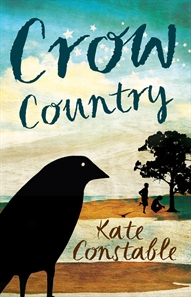
Crow Country

Crow Country by Kate Constable (Allen & Unwin)
PB RRP $15.99
ISBN 978-1-74237-395-9
Reviewed by Thalia Kalkipsakis

‘The night belonged to the ancient, nameless gods, to silent spirits, to Waa and Bunjil and all the others. Sadie dug into the earth, she made a hole in the body of the land, and as she dug, she whispered, ‘I’m sorry, I’m sorry.’

New to Boort, Sadie is resentful of having been dragged to a country town by her mother. Her sense of belonging isn’t helped when she discovers an ancient stone circle and is told by a crow: ‘This is Crow’s place.’

And so begins a series of encounters between Sadie and the cryptic Crow. It hints at a Law that has been broken and sends her time-slipping backwards in time to the death of an aboriginal man who had desperately been defending a sacred place, as well as the cover-up by her great-grandfather.

In between her visits back in time, Sadie’s relationships develop in the present. Walter is an aboriginal boy with a troubled past and Lachie is a descendant of the perpetrator of the crime long ago. There is a sense of righting past wrongs, but also a warning from Crow of repeating history.

Constable has effectively distilled bigger themes into a story that, while shameful and disturbing, also offers hope for the future. Issues such as land ownership, abuse of power and most tellingly, the implications of being part of the cover-up of a crime, are handled with an even hand and understanding. Constable’s background in law is evident, as is her level of care and consultation in terms of Indigenous lore.

Crow Country is aimed at children aged nine to thirteen and is accessible on many levels. The characters and sense of place are vividly and enjoyably Australian. The time slip moments are believable and evocative to the point where this reviewer was hungry for more. It is an important book, one that has the potential to ground its readers, connecting us, as Sadie comes to be, with our country and our collective history.

Thalia’s latest book is called Head Spinners: six stories to twist your brain (www.thaliakalkipsakis.com). 

Saturday, 11 June 2011

My Country

My Country by Ezekiel Kwaymullina, illustrated by Sally Morgan (Fremantle Press)
HB RRP $24.95
ISBN 9781921696916
Reviewed by Neridah McMullin

This book was inspired by my Nana and Gran, who passed on their love of country to me. When I wrote the book I imagined what it would have been like for them as little girls, playing in their country without a care in the world. At the same time, I wanted to encourage self-esteem in Indigenous youth as I feel Australia is in need of more Indigenous heroes. Because all heroes begin as children with a dream, hopefully books like this one bring them closer to that dream” – Ezekiel Kwaymullina

‘My Country’ is an Australian Aboriginal picture book to be enjoyed and celebrated.
It is a book to be poured over and shared between a parent and a child. Whilst the prose is simple and lyrical, it is perfectly matched with the acclaimed Sally Morgan’s illustrations, which are gorgeous and bright, and vivid and intricate. There are double spread pages full of wonder including a smiling sun, happy lightning clouds and friendly animals. There is such a strong feeling of being connected to the earth and the moon and the stars, it’s truly heartfelt and beautiful.

The little girl is on a journey of discovery and the reader is swept along with her. She feels completely safe with her country and is as ‘one’ with her environment. This is definitely something we should all aspire to and encourage our children to explore.

This is a delightful book for a very young audience, aged 3 – 5 years, and is a wonderful book to encourage the imagination and play discovery finding games, and games such as ‘peekaboo’.  For older readers, it’s the perfect book for ‘outdoor’ reading along with paper and pencils to let the imagination flow.

Sally Morgan is a best selling author and internationally renowned painter. She is the author of ‘My Place’, which has now sold over 600,000 copies nationally. This is her first book in over a decade.

Ezekiel Kwaymullina is from the Palyku people from the Pilbara region of Western Australia and this is Ezekiel’s third children’s picture book.

Neridah McMullin is the author of two books for children. Her next book is an Indigenous folklore story called 'Kick it to me!'. It’s an ‘aussie rules’ story that’s being endorsed by the Australian Football League. Neridah loves family, footy, and doing yoga with her cat Carlos (who also loves footy). www.neridahmcmullin.com

Tuesday, 22 February 2011

Caterpillar and Butterfly

Caterpillar and Butterfly by Ambelin Kwaymullina (Fremantle Press)
HB RRP $16.95
ISBN 9-781-863-683-036
Reviewed by Neridah McMullin

This story is about a caterpillar who is too frightened to do anything. She refuses to go with her friends to go the Waterhole in case she falls in, she can’t go to the Tree because she might fall off, or go to the Rock or even watch the Sunset. Everything is too scary and dangerous! And in a way, this is understandable, as Caterpillar is very small and vulnerable.

So Caterpillar hides herself away in her cocoon. This is a magical way for small children to learn about ‘metamorphosis’: how a caterpillar transforms into a butterfly. Even though Caterpillar feels safe she misses her friends. After a while, Caterpillar feels herself changing and growing and realises she’s not scared anymore. She has found an inner strength to live her life. With her fears dispelled, she spreads her wings and flies away triumphantly as a beautiful Butterfly to enjoy all the wonders of the world. Butterfly’s world changes dramatically with her newborn freedom, as she also discovers she’s not the only butterfly in the world.

The illustrations are bright and thoroughly engaging. They are contemporary in style, but still reflective of Ambelin Kwaymullina’s indigenous heritage. When looked upon closely you can see intricately drawn speech bubbles coming from Caterpillar/ and Butterfly’s mouth, reflecting her dialogue. Butterfly lives happily, travelling far and wide to help other caterpillars by passing on what she has learnt. 

Everything around us may seem large and scary, but when we hide from the danger of the world we also hide from the wonder of it, for only when we conquer our fear of falling can we learn how to fly."

This is an enthralling and inspiring story that sends a beautiful and positive message about how important it is to be brave and to believe that we all have an ‘inner strength’ to draw upon in times of need. The realisation that you’re never alone is also an important lesson to be learnt.

A wonderful picture book for children aged 1 – 8 years.

Wednesday, 16 February 2011

Crow and The Waterhole

Crow and The Waterhole by Ambelin Kwaymullina (Fremantle Press)
HB RRP $16.95
ISBN 9-781-863-683-036
Reviewed by Neridah McMullin

Crow lived in a tree by a waterhole. She feels inadequate and unhappy with herself and every morning she stares into the water only to see another crow staring back at her. “She looks like a crow who could change the world. I wish I could be like her.”

Crow bravely flies off on an adventure seeking her destiny. She travels far and wide, helping others along the way and eventually, thanks to Kookaburra, she realises the crow staring back at her, is actually her reflection.

From then onward, Crow eagerly shares this knowledge with anyone she meets who is seeking their own destiny. “Your destiny lies within you. All you need to do is learn how to see it.”

This is a warm and enthralling story and although fable-like, it’s refreshing in its delivery and context of positive re-enforcement and the value of self-esteem. It’s an inspiring book and one for everybody’s book shelf.

There is also a little pink frog that follows Crow everywhere. She can be seen on every page of the book and this will delight young readers trying to find her.

The illustrations are bold and beautiful and bright. They are appealing and engaging and unique with a distinctly indigenous feel to them.

The author Ambelin Kwaymullina is from the Baligu and Nyamal peoples of the Pilbara region of Western Australia and this is her first picture book. She is the daughter of the famed author, Sally Morgan.

A wonderful picture book for children aged 1 – 8 years. 

Monday, 31 January 2011

Savannah Dreams


Savannah Dreams by Lolla Stewart, illustrated by Elaine Russell (Little Hare Books an imprint of Hardie Grant EGMONT)
HB RRP $25.95
ISBN 978-184877382-0
Reviewed by Lillian Rodrigues-Pang

Simply, this book is just beautiful. I highly recommend it to all ages.

Savannah Dreams is an engaging story that contains repetition, humour and most importantly delivers a likeable main character. The story and images work well together to offer a warm insight into community life.

In this book we follow Savannah, the youngest girl, and her family as they go hunting or gathering food. Savannah’s ‘help’ is usually of the trinkets-and-treasure-hunting-type and she finds no food at all for a week. Finally her persistent dreaming and creating pays off and she catches the biggest fish of all.

One of the lovely aspects of the story is that it takes us on a journey in and around an outback community, and we learn of bush tucker in the top end region where the story is set. The family hunt in the creek so we learn of mottled rock cod and stripy mangrove jacks. When the family walk in the mangroves we learn of blue-shelled crabs, sweet-tasting red claw and mud mussels. They hunt on the plains, near the billabong and finally visit the community store. The illustrations depict all of the community areas as a realistically positive and warm place to live.

Illustrator Elaine Russell is an incredible artist. She has authored and illustrated her own books, which include, The Shack that Dad Built, based on her life in La Perouse and A is for Aunty. Elaine is famous for her bold colours and depicting scenes from a bird’s eye view. She uses simple shapes with an attractive blend of colours and lines throughout the book.

Lolla Stewart has a number of titles under her belt, including Aussie Slang Dictionary, The Little Book of Household Hints and The Dream Dictionary. She has written this story with a sweet dose of humour and likability. The combination is a successful one and I recommend this book for the joy of reading and as a learning tool – that is for an insight into bush tucker specific to the top end and the style of artwork used by Elaine Russell.

Saturday, 6 November 2010

Scaly-tailed Possum and Echidna

Scaly-tailed Possum and Echidna by Cathy Goonack, illustrated by Katrina and Marlene Goonack and Myron Goonack (Magabala Books)
PB RRP $12.95
ISBN 978-19221248160
Reviewed by Lillian Rodrigues-Pang

As a start I have to say I love this story and the book. Scaly-tailed Possum and Echidna is the story of how the possum became scaly-tailed and how echidna got his spikes. It is a story told by the Goonack family from the Wunambal people – living in the remote Mitchell plateau region of the Kimberley, Western Australia.

Like the majority of Aboriginal stories it involves a wrong-doing, violence, drama and consequence. These are great stories for children, youth and adults as it involves all the elements we know and enjoy!

The book contains a strong sense of voice. I can hear the depth and lilt as I read. The personal photos at the front and back of the book aid this. In particular the photo at the front of Wilfred Goonack teaching his grandson to cook up crocodile is both personal and beautiful and allows the reader to feel a connection to the people for whom this story is a part of their dreaming.

The beginning of the book also describes the artistic process, which was very interesting. The children, with the support of Janie Andrews produced them. They are all silk-screen images. It made me take a closer look at the art and I wish I could view the original silk screens.

This book is not only a dreamtime story it is also an instructional tool. Until reading this I had no idea that a scaly-tailed possum existed in the far north-west of Western Australia. There is a page of information regarding the scaly-tailed possum, the echidna and the Kandiwal mob and their region at the end of the book. It is refreshing to have a reminder about the broad nature and biodiversity of the land we live in and the people whilst reading a lovely dreaming story.

Thursday, 21 October 2010

The Blue-Eyed Aborigine

The Blue-Eyed Aborigine by Rosemary Hayes (Frances Lincoln Children’s Books)
PB RRP $16.95
ISBN 978-84780-078-7
Reviewed by Heather Zubek

There was almost a sniff of indignation when I learned that not only was the writer of this book not a Western Australian but not even an Australian. Indeed! After reading the book though all is forgiven. The Blue-Eyed Aborigine is based on the diaries of the Commander of the ship Batavia. Those who are unaware of the story are not prejudiced when reading the book. The background story is cleverly and subtlety revealed.

Rosemary Hayes, from Cambridgeshire, UK, recaptures some of maritime history’s most horrific moments through both factual and imagined events. These events are viewed through the eyes of young Dutch sailors Jan Pelgrom and briefly through Wouter Looes.

Those interested in Australian history will be fascinated by the story and the theory that some of today’s Aboriginals in Western Australia are descendants of the survivors of the Batavia. At the time of going to press initial DNA tests confirm that some of these Aboriginals carry Western European blood raising the question about the legacy of the shipwreck survivors. Rosemary Hayes fills in the missing years intuitively and sensitively. We follow the fate of young Jan as he takes to the way of life of the Aboriginals effortlessly and wholeheartedly. The reader begins to feel sorry for the sailor and views his actions during the mutiny as ones borne of survival rather than of a dark heart. 

After reading The Blue-Eyed Aborigine I read a story about the Batavia describing Jan Pelgrom as murderous and cruel. I felt an injustice had been done describing him in this way. It seemed as though they were describing someone else. One will never know I guess. I would like to think that Jan did survive on the shores of Western Australia and become part of the Aboriginal culture. I enjoyed the way the writer concluded the story with visions of blue-eyed Aboriginals coming home from the hunt. It was a fitting end to a rather gruesome tale.

Note: The publishers suggest a reading age of 13+ but I feel that parents should be aware of the adult themes contained in the book.

Sunday, 19 September 2010

Dog Ear Café

Dog Ear Café by Andrew Stojanovski (Hybrid Publishing)
PB RRP $34.95
ISBN 978192166506
Reviewed by Vicki Stanton
http://www.buzzwordsmagazine.com/

I feel like stopping people in the street to tell them that they MUST read Dog Ear Café. It is essential reading for all young adult and adult Australians. Dog Ear Cafe is a powerful recount of Andrew Stojanovski’s time in the central Australian community of Yuendumu where the battle raged to save the community’s youth from a petrol-sniffing culture. Young people were becoming brain-damaged and dying. Along with Walpiri community elders, Stojanovski established the Mt Theo Petrol Sniffing Program which in eight years defeated petrol-sniffing.

However, it was not an easy eight years. How Stojanovski stuck it out, I don’t know. At times his life was threatened and his marriage teetered. Many other good men and women gave their all but were finally exhausted and left.

One of the great strengths of this book is it is written from the heart and with humour but does not gloss over the harsh realities of life in these communities. Stojanovski has a genuine love and understanding of the Walpiri people gained through being open to their ideas and ways. Dog Ear Cafe is by no means an academic text but Stojanovski (an anthropology graduate) gives his theory on how, with all best intentions, many Aboriginal and non-Aboriginal people misunderstand each other. Notions of work and saving, kinship and obligation are vastly different in Western and Indigenous culture. Stojanovski explains the ramifications of these differences on how programs run and their effectiveness.

The success of the Mt. Theo Program was due to both Indigenous and non-Indigenous Australians stepping outside their cultural boundaries, commitment and the building of close relationships. Stojanovski founded the Mt Theo Program with Peggy Nampijimpa Brown and Johnny Hooker Creek (all three were awarded Order of Australia medals in 2005). These two Indigenous leaders put themselves at great personal risk by looking after other clans' children. If something had happened to those youths, they may have been subject to the traditional notion of payback.

Dog Ear Café includes a glossary of many Walpiri words and terms; a list of people and their cultural identity; a list of places; bibliography; maps; and many colour and black-and-white photographs.

Please, please, please do yourself and our nation a favour by reading Dog Ear Cafe. This book most certainly should be in every high school, university and public library. It is a story of overcoming culture clash, and inspiration by people, both Indigenous and non-Indigenous, who cared too much to give up.