Showing posts with label Patricia Bernard. Show all posts

Tuesday, 7 December 2021

WHY PATRICIA BERNARD WRITES FANTASY

I have adored story telling ever since childhood when my third-grade teacher read about the Greek myths to our class. Fantasy, mythology, science fiction, (now called speculative fiction) and historical novels are my favourites genres to write. But that doesn’t mean I can’t spice up my stories with a mystery, a murder or loads of adventure. But deep down it is the world of fantasy and the paranormal that are the most fun to write.

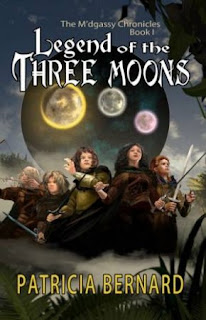
My novels, Legend of the Three Moons and its sequel, Tower of Doom came about during a babysitting job I had with five children, (2 girls and 3 boys). Fearful of the damage they would do to my new red sofas, I took them to Sydney’s Centennial Park. Here I gave each a stick and told them to imagine a weapon, to choose a pet animal or bird to travel with, and to make up a monster creature to attack them in a world that we would plot and name that day. From the game we played that day – we slashed away at the park’s bamboo with our imaginary broad swords, stabbed the earth with our long swords, and shot horrendous creatures with our arrows – was born the M’dgassy Chronicles, the first book Legend of the Three Moons.

I used the children’s names and physical descriptions and began drawing maps of M’dgassy and the wicked High Enchanter’s Fortress in the middle of the mud lake. I love maps -- there is a map in most of my books. I also love quest stories where the heroes fight their way through until the end. I also love creating odd characters such as Hannah the Hang woman. Hannah is taller than any man I know. She is swarthy, has three chins, an untidy topknot of red hair and the muscles of a weightlifter. She wears a dirty blanket and a huge man’s coat buttoned over her big belly. She carries a backpack with saucepans, an axe, and a hangman’s noose. But there is more to Hannah. She doesn’t eat, she can shape- change into someone else, and she wants Swift to be her hang-boy apprentice whether he wants to or not.

There is sly-eyed, twelve-fingered Jessup Birdsnest, an accomplished pickpocket, collector of odd and unusual objects such as magician’s shadows, invisible bird feathers, and wishing jewels. Jessup wears a long black cloak and wide-brimmed pointed hat and comes from Belem an island city full of twelve-fingered people.

I love making up characters whose wriggling fingers dip into other people’s pockets, who offer an apprenticeship to be a hang child, so there are more, such as San Jaagin of the Bird Shop of Belem who saves birds; a one-legged tailor called Roliat (which is ‘tailor’ backwards); and Edith the Oracle who lives in a cemetery with her ghost dogs.

I love Legend of the Three Moons, so imagine my joy when I sent the finished manuscript to Clan Destine Publishing, and they loved it too. Now I am deep into Tower of Doom and the kidnapped Night Parrot Boy. I can’t wait until I reach the end. 

Patricia Bernard's first work to be published was in 1981 under the pseudonym of Judy Bernard-Waite with The Riddle of the Trumpalar which was written with Judy Nunn and Fiona Waite. In 1983 she wrote her first solo book, We Are Tam, and in 1986 she, along with Nunn and Waite, wrote the sequel to The Riddle of the Trumpalar, entitled Challenge of the Trumpalar. From 1988 to 1999 Bernard wrote six more novels including The Outcast Trilogy and one piece of short-fiction which was featured in an anthology edited by Paul Collins. Book one of The Outcast Trilogy, The Outcast was a short-list nominee for the 1997 Aurealis Award for best young-adult novel.

Tuesday, 16 November 2021

Poddy’s Jumper

Poddy’s Jumper by Patricia Bernard, illustrated by Krista Brennan (Cool Dude Books) PB $18 HB $25 RRP ISBN 9780958655385

Reviewed by Kathleen Grace

This colourful picture book is one of a kind. It has been inspired by a nation-wide support for sheep farmers. As Marie Knight says in a foreword, orphaned lambs suffered during a 3-year drought, so she began knitting jumpers to keep them warm. Soon she was getting requests from farmers for 100s of jumpers. What followed was amazing: over 170,000 jumpers were knitted Australia-wide and given to farmers.

Poddy’s Jumper celebrates this remarkable feat. Poddy is an orphaned lamb which, with other orphans, is picked up by farmers Marie and Tony and taken to their farmhouse where they are warmed and fed. ‘What he (Poddy) needs is a woolly jumper,’ says Tony. When their friends learn they are knitting woolly jumpers for the lambs, friends ask for a pattern so they can knit, too. (In fact, if you want to knit a lamb jumper, there is a knitting pattern in the book.)

‘Click-clack went the knitting needles all over the country, as the farmer’s friends, and their friends, and their friends’ friends began knitting,’ reads the text. Everyone in Australian and overseas knit jumpers. There are football jumpers, superman jumpers, even ballet jumpers. Soon Marie and Tony’s house is overflowing with jumpers. Thanks to the media, other farmers receive blankets for their lambs. As for Poddy, he appears on television wearing his favourite jumper. The story finishes happily with Poddy dancing as there are rain clouds in the sky… the drought is soon to end.

This is a delightful book, well-written and illustrated with bright, watercolour illustrations and is sure to be appreciated by readers of all ages.

Note: RRP prices are above. Books are available (with postage) from http://www.patriciabernardbooks.com and are offered with a free eBook in another language (French, Italian, Greek, German, Spanish, Hebrew, and Arabic).

Saturday, 29 July 2017

To the Moon and Back

To the Moon and Back by Dianne Bates (Big Sky Publishing) PB RRP $14.99
ISBN 9781925520293
Reviewed by Patricia Bernard

First let me say that I could not put down this gentle, sweet book. I read it in three days, enjoying every minute of it. To begin with, its title To the Moon and Back is perfect. It reminded me of how I also said the same thing when my children asked me how much I loved them.

This story is as much about Claire’s mother’s breaking-up marriage and the beginning of her new love affair as it is about Claire who is watching, although not always understanding the change in her mother. Claire loves her father and cannot understand why they now live apart from him. She isn’t keen on sharing her father with his new girlfriend and she isn’t keen on sharing her mother with this new man called Mac, who she will never call father. Claire feels bit lost, especially after her father disappears from her life. How does she fit into these new relationships? What is her place? Why don’t her parents love her the way they used to when she was smaller?

The character of Claire is so well written that the reader begins to identify and care for Claire from the book’s first page. As a reader I worried over how the story would end and what would happen to Claire as she moves from school to school, from best friend to best friend and from house to house. I need not have worried:  the author, Dianne Bates, knew exactly what she was writing about.


This book is unique in its treatment of an all too familiar situation for many children. It certainly is an appealing read for both adults and children, especially those between 8 and 12 years. It offers hope and adventure and I love the ending. This is an ideal book for school libraries. There are many children like Claire and To the Moon and Back offers a soothing, gentle way of them easing into the awkward situation of feeling left out.   

Thursday, 19 January 2017

Little Brother

Little Brother by Patricia Bernard, illustrated by Rizaldy Valencia (Blake Education) PB RRP $10.95
ISBN 9781760200909

Reviewed by Dianne Bates

This is a book in the Sparklers’ series which aim to educate and entertain readers aged 6 to 9 years. Little Brother certainly does this and does it well. Set in Malaysia, it tells the story of a small Sabahian boy, Latif, who goes on an adventure with his pet Little Brother to find a home for the orang-utan in a rehabilitation centre in Sepilok.

As it progresses, the fast-paced story takes Latif (and the reader) from the boy’s family longhouse, where Little Brother and other orang-utans have wrecked a plantation nursery, to Kota Kinabalu. There Latif and Little Brother are photographed by tourists who give the boy ringgits so he can afford to catch a bus to Sepilok. On the bus Latif meets an Australian girl Kendra who aims to sponsor an orang-utan at the rehabilitation centre.

The book employs coloured illustrations -- both drawings and photographs -- on every double-page spread so young readers can see aspects of Malaysia from banana plantations to markets to cityscapes. To further inform and educate the reader, there are pages at the end of the book which contain a map (and flag) of Malaysia, facts about the country and a glossary. There is also a story analysis (orientation, complication, resolution) and a short comprehension.


Other books in this series set in south-east Asia and written by Australian Bernard include Goat Girl and Garden Boy, Emilio and the Volcano, and The Talking Hands Guesthouse.

Tuesday, 12 February 2013

The Lost Tail


The Lost Tail by Patricia Bernard, illustrated by Tricia Oktober (FORD ST)
HB RRP $22.95
ISBN 9781921665868
Reviewed by Anastasia Gonis

Illustrator Tricia Oktober has done an incredible job of illustrating the detailed features of the characters in The Lost Tail. Their eyes seem to peer at the reader from the page. She has brought the story to life using vibrant colours to depict the flora and fauna of the forests, and to accentuate the face and body painting, masks and head dresses, and traditional costumes. What can one address first in this exceptional book which concentrates on bringing into focus the traditions and customs of Papua New Guinea?

The Bundi Boys have set out on a five day walk from their village to Goroka (which is the capital of the Eastern Highlands Province of PNG) and the dance festival there. They want to win the competition with their snake dance.  Alfred, the tallest, carries the head of the snake. The others support the body. Nura hears his mother’s voice saying, ‘you are very important. You carry the snake’s tail’.

The boys have been made aware of the dangers they may encounter, but Nura knows that Bundi warriors are never afraid. But after the journey, when sleep overtakes them, Nura awakes to an empty hut, and is filled with fear.

There is now a snake without a tail carrier and a boy alone amongst crowds. He asks a man with a straw in his nose, the women wearing moss wigs, a group of ghost dancers, and two beauty queens if they’ve seen anything. All say no.

He passes drummers in blue-striped skirts, chicken dancers, warriors carrying bows and arrows. Suddenly, he sees the tail. He is overjoyed for the Bundi Boys can’t dance without Nura. But can they win the competition?

This book is beautifully designed by Grant Gittus. The text and illustration have united to provide a spectacular ‘culture tour’ for the reader aged from 5-105 years.