Showing posts with label verse novel. Show all posts

Saturday, 8 June 2024

Sunshine on Vinegar Street

Sunshine on Vinegar Street by Karen Comer, Allen & Unwin Childrens (AU) PB RRP $17.99 ISBN 9781761180132

Reviewed by Sarah Tegerdine

Sunshine on Vinegar Street is the latest verse novel from Karen Comer.

Freya’s entire world is turned on its head in a flash when she and her Mum relocate to Abbotford, an inner-city suburb of Melbourne. Basketball is Freya’s life and heart and being the new girl at school is proving more difficult than expected. Constantly feeling on the outside, she decides to pour everything she has into taking out the best spots in her school’s representative basketball team. However, it is tricky: some of her teammates are not exactly welcoming and contribute to her on going anguish as she tries to fit in.

Freya often reflects on how life was before the move, having both parents close by her basketball team and best friends. The big question in front of Freya is, will she find her place in Abbotsford? Or will she remain perpetually stuck like Audrey, in the town’s symbolic Skipping girl sign.

First and foremost, Sunshine on Vinegar Street addresses change and everything that comes with it. Themes around different family structures, facing, and overcoming fears, bullying, and making new friends also feature strongly. As a verse novel, it is swift and engaging. With its bite-sized scenes and easy to read chapters, I believe it would also be of particular interest to reluctant readers.

Sunshine on Vinegar Street is thoughtful and heart-warming. Its relatability and humour will entertain readers of all ages.


Thursday, 29 July 2021

Mina and the Whole Wide World

Mina and the Whole Wide World by Sherryl Clark and Briony Stewart (UQP) University of Queensland Press PB RRP $14.99 ISBN: 9780702263231

Reviewed by Jeffery E Doherty

Mina wants her own bedroom more than anything else in the whole wide world. And it is almost ready! Just one more lick of sunny yellow paint and it is hers.

Mina and the Whole Wide World is a verse novel by award winning children’s author, Sherryl Clark, and illustrated by Briony Stewart. Mina shares a room with her little brother, and none of her precious treasures are safe around him. Her new room and the freedom and privacy that she longs for, is almost ready… But Mina’s parents take in an unexpected guest, and they give her room away. Mina is so heartbroken that she cannot speak or listen. She doesn’t care that this new boy, Azzami – whose name sounds like a bumblebee – needs a place to stay.

At school, Azzami attracts the attention of bullies and Mina, caught in the crossfire, is left on the outside as well. She wishes Azzami would talk or stand up for himself. When she finds Azzami’s drawings, Mina discovers his story and really thinks about the life of this quiet boy, staying in her room.

Mina and the Whole Wide World is my second exploration into verse novels. I found it easier this time to get into the flow of the story. I read it in one sitting. The text was poetic and evocative, but simply written. The connection to Mina’s shifting feelings draws the reader into her mind and builds an emotional connection to her, and to Azzami, as her connection with him grows.

This book is beautifully written. It is emotional and heart-warming and shines a light on the heartbreak and uncertainty facing refugees, fleeing the dangers of their war-torn homes. But it does this in a gentle way that children can understand and empathise with.


This is a beautiful book and the lovely illustrations by Briony Stewart lift it to another level. I believe this book is both topical and important. It is a book I highly recommend for readers, both young and old.

Saturday, 26 June 2021

Footprints on the Moon

Footprints on the Moon by Lorraine Marwood (UQP) University of Queensland Press PB RRP $16.99 ISBN: 9780702262838

Reviewed by Jeffery E Doherty

Humans are about to leave footprints on the moon, but what sort of mark can one girl make here on Earth?

Footprints on the Moon is a verse novel set in 1969, at the time of the moon landing and the anti-Vietnam War protests, as seen through the eyes of Sharnie Burley a young girl who is starting high school.

Sharnie’s life is becoming complicated; she is struggling to find friends at high school, her older sister Cas is becoming distant and secretive, rifts are growing in her family, and Gran has been forgetting things. Around her, excitement is building about the imminent moon landing, and tensions are building in town around the anti-war protests. Can Sharnie find her own way in this brave new world?

Footprints on the Moon is my first exploration into verse novels. I found it a little strange at first to read. With so few words on the page, it should have been a fast read, but I often found myself going over and examining sections of verse, probably a throw-back from dissecting poems at school. Parts of the text, although poetically written, could easily have been written across the page like a normal prose book, but overall, the verse format certainly fits and works beautifully well. It also helps draw the reader into Sharnie’s mind and strengthens the emotional connection to her.

This book is raw and emotional in a world full of uncertainty. It distils the turmoil of the times through the lens of one young girl, going through her own emotional battles. As such, this book would make an excellent accompaniment to school history texts. For adults who grew up in the sixties and seventies, the story releases a wave of nostalgia for those times. Although Footprints on the Moon uses historical events, the emotional uncertainty explored in the book is just as relevant today.

This is a wonderful book that I believe readers, both young and old, will adore.

Sunday, 28 October 2018

Sukie’s Suitcase

Sukie’s Suitcase by Jordie Albiston, illustrations Keira de Hoog (Little Barrow Press) PB RRP $15.00 ISBN 9780992584511

Reviewed by Dianne Bates

Sub-titled ‘Three picture-poems’, this book for children 8 to 12 years is essentially a three-story verse novel. The title story begins with the words ‘Sukie was running away from her life’ -- even though her life was not ‘all that bad’. Having packed her suitcase she walks a long distance during which time she loses her bag. Happily, she discovered objects which she’s lost. Good news is that they lead back home where she lives happily ever after.

The first story in the book is narrated by Felipe, new to Australia from South America. He can’t seem to fit in and is homesick for Bogota as nothing in this new country compares. Sitting under a tree he is hit by what he describes as ‘a leather lemon’: in fact, it’s a red football. When he meets a girl called Nikki, it seems he’s going to be fine after all.

The final story is ‘Three Steve Bikos’, narrated by Steve Biko who lives in Kenya. Like the other stories, this is a rambling tale of life in a foreign place with lots of details about Steve’s life and lots of telling.

This is likely to be a difficult book for the intended readership. There are many foreign words ((‘ajiaco’, ‘guasca’, ‘arepa’, for example), and there’s also a problem with the font (Just Alice) which is written over illustrations at times, making it difficult to read.
The illustrations are interesting and unusual with de Hoog employing many photos overlaid with sketches.

The author Jordie Albiston is highly regarded, both in Australia and overseas, for her poetry. This is her first book for children.

Monday, 16 July 2018

Leave Taking


Leave Taking by Lorraine Marwood (UQP) PB   RRP $14.95 ISBN: 978 0 7022 6011 7

Reviewed by Dianne Bates

Here is a new verse novel for younger readers from the celebrated author of Star Jumps, the 2010 winner of the Prime Minister’s Award for Children’s Fiction. The theme of Leave Taking had its genesis in the author’s own (successful) battle with cancer and her move away from the farm where she raised her children. Basically, this book is a journey through grief and a celebration of hope, with Toby, his mum and dad, leaving their family farm after the death of Toby’s younger sister, Leah. Together, they sort through all their belongings and put things aside to sell or throw out. It’s a big task, and naturally Toby doesn’t want to leave the only place he’s called home.

As his last day on the farm approaches, Toby has a plan -- to say goodbye to all the things and places that mean something special to him and Leah, from the machinery shed and Pa’s old truck to the chook house. With the help of his best friend, Trigger the dog, he learns what it means to take your leave.

As Toby says good-bye in this final week, he experiences camping, a clearing sale and a bonfire night, meanwhile undertaking chores such as milking cows, tidying up and packing.

This is a gentle story with no dramatic moments; the story action rolling smoothly through the course of the last week on the farm.

Written in easy-to-read free verse, the book will appeal to readers aged 7 to 10 years who prefer short sentences and stanzas with plenty of white space and pared-back descriptions. Simple black and white line illustrations scattered through the book with drawings on the fly pages add to the book’s appeal.

Tuesday, 5 December 2017

It’s your world


It’s your world a verse novel by Kristy-Lee Swift (guillotinepress), PB  ISBN 9780995399136Reviewed by Pauline Hosking

It’s Your World is divided into short poems which each progress the action, rather like the work of Steven Herrick. Kristy-Lee Swift experiments and plays games with language, using rhymed and unrhymed sequences and lots of puns.

I am not a poet so can’t comment on the quality of the verse, but I certainly enjoyed reading about Evie, an unhappy fifteen-year-old. Her mother has died soon after she was born. It’s rumoured that she committed suicide. Evie has a difficult relationship with her controlling father and religious grandmother, both of whom think she’s ‘bad’. Evie doesn’t believe she is evil, just up to no good. Her only hope seems to be to find free-spirited Aunt Ruth who moved to Sydney and has been out of touch for years.

When her father has a brain haemorrhage, Evie goes to live with her grandmother. This is worse than prison. She escapes with her brother, her crush Nigel and her two best friends to celebrate New Year’s Eve. They get drunk, and she spends the night in the cemetery with a boy who isn’t Nigel.  

Evie’s father comes home. Because he has mild brain damage and is not aware of what is going on, Evie feels she now has a degree of freedom. She invites friends over, including Nigel. When her father stumbles on the scene he is furious and physically attacks her.

Evie flees to Sydney and finds there an aunt who understands and can explain the true circumstances surrounding the death of her mother. Aunt Ruth offers this comfort: ‘’There’s no such thing as a happy ending. But there can always be/a happy/keep on going.”

The poems about Evie’s lost mother are deeply moving. Others are cute, clever and often funny. Though I would have liked one or two more sequences on Evie and her father when he was recovering, this is an intriguing read. Evie is a complex, always understandable character. Her confusion, desires and pain will strike a chord with many adolescent readers.   


Friday, 14 November 2014

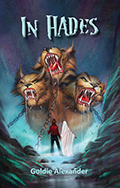
In Hades


In HadesIn Hades by Goldie Alexander (Celapene Press)
PBK RRP $16.95
ISBN 978-0-9750742-6-8
E-book ISBN 978-0-9750742-5-1

Reviewed by David Campbell

Homer’s Odyssey might seem an odd choice as the basis for a story written for young adults, but if that classic poem were to be described as the original ‘road movie’ then what Goldie Alexander has achieved with her verse novel In Hades suddenly begins to make a lot of sense. Over the years there have been many famous road movies, from our own Mad Max and The Adventures of Priscilla, Queen of the Desert, to the likes of Hollywood’s Easy Rider, Thelma and Louise, Rain Man, and Little Miss Sunshine.

That’s a fairly mixed bag, but the common thread throughout is the journey undertaken by the central characters, a journey of discovery and self-revelation. Alexander has explored the complex notion of redemption though the adventures of Kai, a 17-year-old boy who, in a daring plot-twist, dies at the very beginning of the story when he crashes a stolen car. Kai’s younger brother Rod, who is autistic, is also killed in the crash, and it is Kai’s search for Rod in Hades that leads him to encounter all manner of monsters and physical challenges that have to be overcome.

But In Hades is not just a gripping adventure tale, it’s also a love story, for Kai meets up with the anorexic Bilby-G, and their journey together becomes one of mutual self-discovery.

This is an ambitious project, and one of the keys to its success is the poetry, for Alexander has effectively managed the difficult feat of marrying the action (and the romance) to the rhythms and cadences of the verse. The book is not one poem, but 49 of them, each with its own distinctive structure and voice. So we begin with the dramatically brief opening (The Accident), which scatters words on the page as we might imagine the shattered wreckage of the car strewn across the road, and then moves to the more tightly structured, yet still confused, second poem (After!), in which Kai comes to the realisation that he is dead.

Bilby-G arrives on the scene in poem 15 (Meeting Bilby-G), but before then we have learnt something of Kai’s troubled background, most of his problems arising after his step-father walks out (he doesn’t know his biological father) and takes up with another woman who rejects the two boys. Kai’s experiences during this time will resonate with quite a few young people and provide a useful basis for discussion, the poem titles alone striking a chord…for example Sleeping Out, Street Kids, and No Fixed Address.

The rest of the book follows Kai and Bilby-G as they are, in a sense, reborn, rediscovering the people they were before their lives went downhill. We learn what brought Bilby-G to this point, and begin to see the degree of guilt that haunts both of them and the truth that has to be faced, best summed up by an old man they meet along the way who tells them that they must seek forgiveness and then forgive themselves if they are to find peace. The physical challenges they encounter, which include a dangerous sea voyage involving whirlpools, sea nymphs (shades of Ulysses and the Sirens) and, finally, a one-eyed monster, provide the means to this end.

The book operates on several levels. Firstly, there’s the “What happens next?” element of the story itself, finding out who (and what) Kai and Bilby-G meet, and how they react. Then there’s the background, the events that led up to their deaths and the sort of people they were…there’s ample material for debate in the way they interacted with their families and the understanding they eventually come to about that. And finally there’s the poetry itself, with the multitude of formats providing the stimulus for discussion about the use of language and poetic structure to enhance the ancient art of story-telling.

This last, for me, is the most interesting, but that won’t be the case for everyone. Responses to poetry are, naturally, very subjective, and the challenge for those unfamiliar with the genre will be to come to some understanding of what the writer is trying to do. That doesn’t mean universal agreement, of course, and there are certainly some sections that I would have tackled differently, but that is where verse can add an extra dimension to the tale being told. There is considerable value, and much to be learned, in teasing out the various techniques employed and looking at possible alternatives. This not only enhances appreciation, but prompts readers to take an interest in having a go for themselves.

The inventive use of language is a powerful instrument, and I recommend In Hades as something out of the ordinary that should provide an excellent source of stimulating material for a variety of young adult readers.

You can purchase this book through  www.celapenepress.com.au


Sunday, 31 August 2014

Caminar

Caminar by Skila Brown (Walker Books)
HC RRP $ 24.95
ISBN 9780763665166
Reviewed by Anastasia Gonis

This stunning verse novel is Skila Brown’s conduit for the real life events of the era beginning in 1954 when the first democratically elected government of Guatemala was overthrown. The Guatemalan Civil War raged between 1960 and 1996. It left more than 200,000 people killed or never heard of again. This book is dedicated to their memory.

The setting begins in Chopan, Guatemala, 1981. When the soldiers arrive, they encourage the hungry villagers to betray the ‘communists’ for money. The word communist is unknown there. But they reinforced their message in their language, by hanging a man with the word communist a necklace around his neck.

Carlos is a boy forced to become a man to survive because work made a boy ‘step away from child, and step into Man.’ Later the villages are razed to the ground and people are slaughtered like sheep.  On the day his cousin is born, Carlos’ mother sends him into the jungle to pick mushrooms. ‘I could not see the village. And it could not see me.’ He follows his mother’s orders to set out for the mountains if the soldiers come and ‘in the woods, eyes closed, ears open’ he listens to the slaughter and death behind him as he hides in trees like a monkey. We accompany his travels and fears, his growth and his mourning.


This verse novel is poetic and powerful, heartbreaking and mournful, but stops a breath away from being desolate. The author has used the power of the elements, emotive language and metaphor to portray all that we see, hear and almost smell. The plants, streams and forests must surely be as familiar to her as breathing for they appeared as strong visual scenes before me throughout the book. This is a feast of language of the highest quality; a work of incredible depth.