Showing posts with label Daniela Andrews. Show all posts

Thursday, 29 June 2017

The Castle in the Sea (Quest of the Sunfish 2)

The Castle in the Sea (Quest of the Sunfish 2) by Mardi McConnochie, (Allen and Unwin)  PB RRP $14.99
ISBN 9781760290924

Reviewed by Daniela Andrews

The sailing adventures of Annalie, Will, Essie and Pod continue in the second ‘Quest of the Sunfish’ book, as they desperately search for Spinner. The story picks up about three weeks after the foursome escaped from Little Lang Lang Island, armed with the names of four important scientists. This novel focuses on their quest to find and talk to each scientist in the hope they’ll find Spinner. Their journey is highly dangerous. Aside from the ongoing threat of roaming pirates, they need to remain hidden from the Admiralty and, especially, Beckett (who is still pursuing them relentlessly). Then there’s the weather. The book begins with a ripper of a storm that causes two characters to become lost at sea … and the action never loses pace thereafter.

As per the first book, this is a highly gripping page-turner. The chapters are short, and there’s action aplenty. Mardi McConnochie slips in a few more details about the Collodius Process and why the research must be kept hidden from the government at all costs. She also clearly sets the direction for the closing novel in the trilogy, to be released in September 2017 – the foursome must make their way to the final scientist on the list, who lives on a mysterious island with extremely guarded borders. 

McConnochie occasionally offers the occasional recap as to what happened in ‘Escape to the Moon Islands’, but reading the first book is necessary to appreciate the background of the journey. There is also very little focus on the personalities and background stories of Annalie, Will, Essie and Pod in this one. The characters might not seem particularly interesting, or even likeable, without having read the first novel in the series. (The first novel has, incidentally, been shortlisted for the Readings Children’s Book Prize 2017.) The novel should appeal to 9–12-year-olds who like adventure stories, along with readers who have an appreciation and love for science.


Wednesday, 21 June 2017

Our Last Trip to the Market

Our Last Trip to the Market written by Lorin Clarke and illustrated by Mitch Vane (Allen and Unwin)  HB RRP $24.99  ISBN 9781925266962

Reviewed by Daniela Andrews

Markets are great, aren’t they? Oh, the atmosphere! The incredible smells! Fresh foods! Now imagine sharing your trip to the market with six kids in tow … hmm. Perhaps the word ‘last’ in the title refers not so much to the most recent trip, as it does to the Last Ever.

This entertaining picture book, with hilarious full-colour illustrations by Mitch Vane, is sure to strike a chord with frazzled parents everywhere. The mother in this story is, shall we say, super upbeat. She is not at all daunted by the fact that she’s daring to take six kids, including a toddler and a couple of preschoolers, out grocery shopping. She’s happy, and positive and full of bright energy as she takes in the sights. Her kids, meanwhile …

One is stealing a juggling ball from a busker, another is knocking over a pile of doughnuts. Two have stolen a wheelbarrow. One is digging through a sack of lentils. Another has found some sparkly glue.

Though the mother briefly pauses in her market merriment to discipline the children (‘Please give that back to the man’), she never loses her cool. Why would she? She’s at the market! The glorious market! The story keeps its rhythm as she continues on her way, buying far more things than she intended. The only time she expresses any anxiety is when she realises they’re running late for Grandma and Gramps. As market-goers and stall-owners watch the family, horrified by the trail of destruction they’ve left behind, good old mum suggests they’ll get to the car faster if they ‘stomp like a pack of wild boars’. Why not? Off they go, ‘stompity stomp’, but not without a couple more mishaps on the way. Just when I start to doubt the mother’s neverending patience, the story ends with some sweet revenge on her part. Phew!

Lorin Clarke has written a fantastic story made highly amusing by its unpredictable rhymes and funny caricatures. There is much to see in the illustrations and Vane perfectly captures the children’s cheeky expressions (or innocent curiosity). I particularly loved the gleam in the mother’s eyes on the last page.

The story is suitable for children aged 2 – 5 years … and parents. Of course, parents


Sunday, 18 June 2017

The Australian Animal Atlas

The Australian Animal Atlas written by Leonard Cronin and illustrated by Marion Westmacott (Allen and Unwin)  HB RRP $29.99 ISBN 9781760294144

Reviewed by Daniela Andrews

Where, in Australia, might you find a red-headed honeyeater? What’s the wingspan of a gum moth?  Is there such a thing as a legless lizard? This 48-page reference book is jam-packed with information on 176 species of Australian animals.

The information is separated into habitats, with a selection of 16 animals per spread. The list of habitats is quite extensive and impressive: Deserts, Mangroves, Mallee and Acacia Scrublands, Waterways, Forests and Woodlands, Seashore, Rainforests, Heathlands, Tropical Wetlands, Alpine and Urban. Each habitat is introduced with 1–2 paragraphs describing its unique features, climate conditions and importance to the ecosystem. Each is accompanied with a small map of Australia, colour-coded to show the locations of that habitat. 

Each section of the book comprises four pages. The first double page spread (which opens with the habitat information) includes a large look-and-find illustration. The margins feature small pictures of 16 animals that are hiding in the main picture. Each of these animals is described in further detail on the double page spread that follows. The font is on the small size, as a result, but the writing is great – Cronin has focused on lesser known facts about each animal and perfectly summarised these with an entertaining caption beneath each species name. For example, the caption for the spotted cuscus is ‘smelly chest’, and the paragraph beneath explains how smelly oil from the male’s chest is rubbed onto tree branches to mark out a territory.

The illustrations by botanical artist, Marion Westmacott, are in full-colour and look extremely realistic – some almost photographic in quality! The endpapers feature a lovely trail of animals, first wandering into the book and later wandering out. The pages of the book are glossy and white throughout, which really helps lift the illustrations off the paper and bring the detail to life.

The book will appeal to kids who love Australian wildlife, particularly those aged between 6 and 12. It would be a great addition to the classroom shelf, especially beside existing collaborations by the same author and illustrator.


Saturday, 17 June 2017

Captain Jimmy Cook Discovers X Marks the Spot

Captain Jimmy Cook Discovers X Marks the Spot written by Kate & Jol Temple and illustrated by Jon Foye (Allen and Unwin) PB RRP $12.99
ISBN 9781760291945

Reviewed by Daniela Andrews

Jimmy Cook is, to put it simply, an explorer. Actually (if you can excuse his modesty), he’s pretty much ‘the greatest explorer that ever lived’. After he discovered the third grade, in the first book in this series, he was rather inspired by the historical feats of  ‘the other Captain Cook’. In this, the second ‘Jimmy Cook’ story, he has found a humungous dinosaur footprint … so now he’s busy digging away to find its bones. And give it a name. (‘Jimmyosaurus’ anyone?)

Much to his teachers’ annoyance, Jimmy seems to have developed quite a team of student diggers at the school … especially since he found that map marking X for treasure. Forget the dinosaur, he is about to discover something better … something real. Can he get to it before that show-off, Alice Toolie, does?

Jimmy records his daily adventures in his journal, noting always the weather that day (eg ‘hailstones the size of rhinoceros beetles’) and drawing a picture to illustrate his inventory (eg the ‘arm of a robot toy’). The inventory and weather observations don’t always have any bearing on the story, but are amusing introductions to each chapter. The journal entries are interspersed with funny black and white penciled illustrations by Jon Foye. Almost every page features an illustration, making the design highly attractive to readers aged 7 – 10. 

The three talented creators behind this book have released four children’s books together including I Got This Hat, the book selected for National Simultaneous Storytime in 2016. Their complementary styles work well together, offering the right blend of humour and action, with a dash of nonchalance. Jimmy’s innocent observations about his world are laugh-out-loud funny. Can’t wait to see what he discovers next!


Friday, 16 June 2017

The Blue Cat

The Blue Cat by Ursula Dubosarsky (Allen and Unwin) PB RRP $19.99
ISBN 9781760292294

Reviewed by Daniela Andrews

‘“If that cat could speak,” she said, rolling her eyes to the ceiling, “imagine the stories he would tell.”
Personally, I felt I would rather not know.’

The blue cat appeared around town about the same time as Ellery did, according to the narrator, Columba. Ellery is a new child at her school, a European refugee who doesn’t (or doesn’t want to) speak. The blue cat is thought to have come from one of the navy ships at the wharf. Was it tossed overboard, or did it flee? Columba and her next-door-neighbours, who have befriended the cat, can only guess at the cat’s background as they quietly contemplate the atrocities it has probably seen. (‘… His body shakes when he’s asleep with secret anger dark and deep.’)

The mysterious blue cat disappears after hearing the blast of noisy sirens for the practice air raid. Columba bands together with Ellery, and her resourceful classmate Hilda, to search the streets of Sydney. But as the story transcends into a haunting alter-reality, we are left to ponder whether Columba is searching for a blue cat … or whether she’s searching inside herself for the answers to the meaning of the war.

Award-winning Dubosarsky combines her lyrical style with historical documents to tell this fascinating, fairy-tale like story of the friendship between a boy and a girl in Sydney, 1942. Her writing beautifully captures the innocence of children caught up in a war, starkly contrasted, for example, against a documented government order for ‘Enemy Aliens’ or a black and white photograph of Hitler at the Eiffel Tower.

The story targets 10–14 year-olds but will likely appeal to a wider readership, especially lovers of literary historical fiction. This powerful reflection on war will settle quietly in your heart and linger, long after the final page.


Wednesday, 14 June 2017

Diary of an AFL Legend

Diary of an AFL Legend written by Shamini Flint and illustrated by Sally Heinrich (Allen and Unwin) PB RRP $9.99 ISBN 9781760295141

Reviewed by Daniela Andrews

Nine-year-old maths extraordinaire, Marcus Atkinson, is (shall we say) a good sport. (Not to be confused with the phrase ‘good at sport’.) He has so far bitterly sucked at cricket, track and field, basketball, tennis, soccer, swimming, taekwondo, golf and rugby. Yet there he is, at the opening of the tenth novel in this popular series, buried ‘under an AFL pack’. Oh Marcus. 

Let’s blame his perfect cousin (Spencer) who should really know better by now, right? Marcus progressively messes up the rules of the game in his special, flawlessly uncoordinated way. Despite his father (the self-help book novelist) having a philosophical conversation with him about the pursuit of happiness, he stubbornly refuses to give up. There’s no way he’s going to let Spencer down. When Spencer and his father secretly come up with a way to help Marcus miss an important game, believing they are doing him a favour, Marcus finds a way to turn up anyway … and puts on quite a show.

This latest installment in the (non) sporting series for 7–11-year-olds is chock full of hilarious, face palm moments that we’ve come to love and appreciate from Shamini Flint. The format of the book matches the others. The story is told via diary entries, each highly illustrated with the amusing black and white cartoons of Sally Heinrich. (The majority of the text actually appears in speech bubbles within the illustrations.) The narrative in the diary entries connects to the text in the speech bubbles, so there is perfect flow between the two. For example, Marcus writes ‘I asked Dad …’ and then we see a cartoon of Marcus and his father with the question in the speech bubbles. The diary entries also feature the odd ‘post-it note’ from his sister, supposedly reading and annotating without his permission.

The ending was great – very credible and totally in line with Marcus’ character and, er, his sporting prowess. Shamini Flint has once again provided an entertaining read with a clever way of inadvertently teaching her readers the rules of a sport.


Monday, 12 June 2017

Spellslinger

Spellslinger by Sebastien De Castell (Allen and Unwin) PB RRP $19.99
ISBN 9781471406119

Reviewed by Daniela Andrews

Kellen is almost sixteen years old and rapidly approaching his magical trials. Will he become a mage of Jan’Tep, like his powerful father Ke’heops? Or will he instead be declared an unmagical ‘Sha’Tep weakling’, destined only to serve a mage? The pressure is on. His younger sister, Shalla, has already sparked magical bands in multiple disciplines, but Kellen has none.

Desperate to avoid the shame of being declared Sha’Tep, Kellen passes his first trial by tricking his opponent into believing he is performing a spell against him. (‘Magic is a con game.’) Shalla pronounces him a cheat and then casts her own spell against him, hoping he’ll find some magic within to shield it. He doesn’t – and she nearly kills him. Fortunately, a mysterious stranger (Ferius Parfax) saves his life.

Ferius, whom the townspeople suspect to be a Daroman spy, empathises with Kellen and continues to look out for him. When Kellen discovers the shameful truth about the Jan’Tep people, and becomes a victim of their cruelty, he turns to Ferius – and a smart-mouthed squirrel cat, Reichis – to help him escape and find his own destiny instead. But who exactly is Ferius, and why is she so keen to help Kellen?

Spellslinger is the first YA fantasy novel in a new set of six books by Sebastien De Castell, author of the Greatcoats series. He describes the book as being set in the same universe as his Greatcoats series, but on a different continent – one ‘more akin to the American frontier’. The dark, western feel makes it quite a unique, magical story! The novel is fast-paced, told in first-person perspective, and broken up into four parts representing Kellen’s magical trials.

Essentially, it’s the story of a teenager trying to find himself. It’s about how he stands up to those who shame him, and finds his own direction in life. Kellen stops striving to become a Jan’Tep after he learns that ‘there’s no amount of magic in the world that’s worth the price of a man’s conscience’. With the support of Ferius and Reichis, he is ready to assume his place as the ‘Spellslinger’; a role that Ferius predicts ‘might just change the world’. Kellen leaves behind a trail of allies and enemies that will no doubt make the forthcoming books rather action-packed!


Friday, 2 June 2017

Defy the Stars

Defy the Stars by Claudia Gray (Allen and Unwin)  PB RRP $19.99
ISBN 9781471406362

Reviewed by Daniela Andrews

‘She’s learned how to fight. Next she has to learn how to die.’

Noemi, a seventeen-year-old soldier from the planet Genesis, has three weeks to live. Her assignment to strike and destabilise the gateway to her planet will buy her people time in the war against Earth … at the cost of her own life. When Noemi veers off-course during a sudden attack from Earth, she discovers an abandoned ship with somebody onboard: Abel. A robot.

Abel is the long-lost creation of Burton Mansfield, an Earth-residing scientist whom some believe is a genius, others evil. The only ‘A’ model mech he’s ever created, Abel’s skill and cognitive reasoning is outstanding but his 30 years of isolation have produced a flaw in his programming. He has developed an ability to feel. When Abel reveals he knows how to destroy the Genesis Gate, Noemi orders him to help her secure the required items before she sends him to his death at the gate. (He is only a mech, after all.) But as they traverse the universe, and form a loyal alliance, Noemi feels uneasy about destroying him. Plus, the more she learns about the other planets the less she agrees with her home planet’s choices.

This is a fast-paced, gripping read by bestselling YA author, Claudia Gray. Noemi and Abel’s stories are told in alternating chapters in third-person perspective, and the progression of their relationship is fascinating. Abel’s near-human conscience constantly grapples with Noemi’s orders and his loyalty to Mansfield, providing much suspense in the story as to how he will act. Abel undergoes quite an existential battle as he tries to understand the motives behind Noemi and Mansfield’s opposing requests and behaviours. When caught in a terrorist attack, he:
‘… finds it hard to comprehend that humans don’t share the same directives he does. That their innermost beings don’t demand that they help protect one another’s lives. Shouldn’t that matter to a human even more than it does to a mech?’

The book is suitable for science fiction fans aged 12–18 years, but I believe it will appeal to a wider and older audience also. Outside of its planetary attacks, galactic descriptions and battleship commands is an enthralling relationship between two engaging characters … and a heartrending moral reflection on human nature.


Monday, 29 May 2017

Henrietta and the Perfect Night

Henrietta and the Perfect Night by Martine Murray (Allen and Unwin)
HB RRP $16.99   ISBN 9781760290245

Reviewed by Daniela Andrews

Fans of Henrietta the Great Go-Getter will be pleased to discover this hardcover book by Martine Murray, featuring five new Henrietta stories.

Henrietta is just as spirited and adventurous as ever: ‘I’m an explorer of life, and that includes trees, bugs, animals and all mysteries.’ In this collection, she practices how to be patient and be a good big sister (‘The Waiting Game’), how to rescue somebody and make a friend at school (‘The First Day’), how to survive a sleepover with the pesky older brother of her best friend (‘The Sleepover’), how to save the school play when the lead gets stage fright (‘The School Play’) and how to adjust to life with a new baby brother (‘The Arrival’). The stories need to be read in sequence to be properly enjoyed, with the title alluding to the final story’s conclusion.

The book is illustrated in full colour by Martine Murray, award-winning author of How to Make a Bird and Molly and Pim and the Millions of Stars. Each double page features an illustration to break up the text, making this a great novel for readers aged 5 years and older who are starting to read chapter books. The design is likely to appeal to the age group too, with key phrases appearing in an alternate font of different size or colour.

Henrietta is ‘a Big Thinker’ and her thoughts and observations are highly amusing! The stories are told in first-person perspective, allowing the author to offer fantastic examples of friendship, courage and kindness without seeming to preach these values to her readers. (‘You only need one friend in a room full of strangers to feel perfectly happy.’) Henrietta is, at times, bold and sassy, at other times quiet and afraid, but the range of emotions she feels gives scope to her situations and makes her very real and lovable.


Friday, 26 May 2017

Little People, Big Dreams: Agatha Christie

Little People, Big Dreams: Agatha Christie written by Maria Isabella Sanchez Vegara and illustrated by Elisa Munsó (Quarto Group UK)
HB RRP $18.99  ISBN 9781847809599

Reviewed by Daniela Andrews

When Agatha Christie was a young girl, she would read lots of books with her mum … and she always offered ‘a better idea for how the story should end’! It seems she was always destined to be a writer, as showcased in this title in the ‘Little People, Big Dreams’ series that highlights successes of high-achieving women in history.

Agatha’s wartime nursing experience taught her much about poisonous concoctions, and her imagination ‘wouldn’t stay quiet’. After the war, she began to write her own stories – great, murderous thrillers that hooked her readers immediately. She invented the great detectives, Hercule Poirot and Miss Marple, and many of her books became stage productions.

This hardcover picture book conveys Agatha’s story in simple text targeting readers aged 5–8 years. Each double-page spread features no more than 1–3 sentences. A longer biography appears at the back of the book, featuring four black and white photographs. It mentions the success of And Then There Were None and Murder on the Orient Express, detailing how her particular writing style made her ‘the queen of mystery’. It also mentions her baffling disappearance in 1925 – a personal mystery that sparked a nationwide search!

The illustrations by Elisa Munsó are black and white, with selected splashes of red – especially striking and appropriate for a writer of murder mysteries! (I particularly loved the page showing a black and white cemetery, featuring the headstones of some of her murder victims, with an elderly Agatha looking on in her bright red coat.)

Other women featured in the ‘Little People, Big Dreams’ series include Amelia Earhart, Frida Kahlo, Coco Chanel Maya Angelou and Marie Curie. This terrific series of books is definitely aiming to empower children (particularly girls) to follow their childhood dreams and make a difference in the world.


Wednesday, 24 May 2017

Where’s The Ballerina?

Where’s The Ballerina? by Anna Claybourne, illustrated by Abigail Goh (Quarto Group UK)  HB RRP $19.9   ISBN 9781782404507

Reviewed by Daniela Andrews

Some of the greatest stories in the world are presented as ballets, but their meaning can be lost amongst young audiences. ‘Don Quixote’, ‘Swan Lake’ … even ‘The Nutcracker’ can seem confusing. When I first picked up this charming, full-colour picture book, I thought it would simply be a look-and-find, ‘Where’s Wally’ style of activity book.  I was glad to discover it was much more than that – it is also a kid-friendly reference guide to ten different ballet productions.

The ballets presented in the book are: ‘Swan Lake’, ‘Romeo and Juliet’, ‘Giselle’, ‘The Nutcracker’, ‘La Bayadère’, ‘Coppélia’, ‘A Midsummer Night’s Dream’, ‘The Sleeping Beauty’, ‘Don Quixote’ and ‘Cinderella’. Two double-page spreads are devoted to each ballet. The first is an introduction. It features a plot synopsis, setting description and full-colour storyboard, accompanied with text, depicting seven main scenes from the ballet. The second double-page spread offers the look-and-find activity for that particular ballet. The illustration for the task is always a scene from that ballet, and readers need to find 5 - 7 hidden characters from that ballet. (For example, for ‘The Nutcracker’, they need to find Clara, The Nutcracker Prince, Dr Drosselmeyer, The Mouse King, The Snow Queen, The Sugar Plum Fairy and Mother Ginger.) As an added bonus, there is always a hidden peacock lurking amidst the scene, along with a ballerina in a white tutu. The answers have been included at the back, and are cleverly presented as darkened stage scenes with spotlights shining on the hidden characters.

This beautifully presented hardcover book is suitable for 5–8 year-olds, and would make a beautiful gift for a child about to start dance lessons or who is generally interested in ballet.


Tuesday, 23 May 2017

The Night Gardener

The Night Gardener by Eric Fan and Terry Fan (Quarto Group UK)
HB RRP $24.99  ISBN 9781847809391

Reviewed by Daniela Andrews

Something magical is happening at Grimloch Lane … trees are being shaped into astounding animals overnight, giving the residents a new surprise to wake up to each morning. William, a boy at the local orphanage, is filled with wonder. First, he wakes up to a huge owl. Then, a cat. One day, it’s an enormous dragon, fit for climbing on. Suddenly, the trees look alive … and so do the people. Neighbours unite to marvel. No longer do they walk alone, heads down. They speak to one another. They laugh together. The crowds grow.

One night, William spots the elusive ‘Night Gardener’ and follows him to Grimloch Park. The gentleman knowingly turns and smiles at him: ‘I could use a little help.’ He teaches William his craft and, together, they work all night to create a magical zoo wonderland. The Night Gardener is not there when William awakes, but it seems the entire town has congregated in the park, in awe.

The story closes with a heartwarming message – though the Night Gardener has gone, and the leaves have long fallen from the trees, the people of the town have changed. They find other reasons to come together. And William, who received the man’s garden shears as a parting gift, continues his legacy in topiary art.

This stunning book has been written and illustrated by two brothers, Eric and Terry Fan. The illustrations are breathtaking, imbued with the perfect colours to evoke the text’s emotions. They are black and white at first, but begin to come to life as the Night Gardener works his magic. The topiary trees appear in vivid green hues, showing life against an otherwise drab town. People start to come to life too, slowly receiving colour in their clothes and facial expressions. The seasons are portrayed in realistic hues, with autumn colours, especially, leaping off the page. The entire town finally appears in colour on a striking double page spread near the conclusion. The illustrations are a combination of ink and graphite mixed with digital colours. (The detailed linework reminded me a little of the work of Ron Brooks!)

This story is a beautiful salute to the magic of nature and its power to bring people together. It will suit readers aged 6 and older.


Friday, 19 May 2017

Hotaka: Through My Eyes


Hotaka: Through My Eyes by John Heffernan (Allen and Unwin)
PB RRP $16.99  ISBN 9781760113766

Reviewed by Daniela Andrews

When media attention dwindles, we are left to merely imagine the after-effects of a natural disaster. How does a community recover from such a large-scale event? How do people unite to rebuild lives and towns when, in fact, so many are mourning their loved ones?

This novel, set in Japan, is the first in a promising new spin-off set of ‘Through My Eyes’ books (created by Lyn White) focusing specifically on natural disaster zones. The story is told from the perspective of a boy named Hotaka, and begins on March 11, 2011 – the day the northern coastline of Japan was struck by a tsunami that killed around 16,000 people. John Heffernan, who spent a month in the damaged Tōhoku region of Japan to research the novel, vividly describes the residents’ chaos and fear in a gripping, nail-biting introduction.

The story then cuts to 2014, three years later. The entire region is still a construction site. Many people are living in sub-standard accommodation. Hotaka is mourning both his friend, Takeshi, and his grandfather. Haunted by memories of that fateful day he tries to busy himself organising a memorial concert, enlisting the help of his two best friends (Osamu and Sakura). Sakura starts getting fired up about the seawall the government has arranged to build, and Hotaka doesn’t initially understand why. His beloved Uncle Yori explains it better: ‘We’re part of Nature. We can’t shut it out with walls. We have to live with it, not against it.’

Sakura, whose own tragic past is eventually revealed, starts a major community revolt against the wall, against the government and against the construction company. Together with Hotaka, Osamu, and the power of social media, their campaign reaches far and wide … but it seems the corrupt mayor will stop at nothing to silence them.

This uplifting work of historical fiction, targeting readers aged 11–14 years, is a compelling read in or outside the classroom. Its themes cover family, friendship, identity, community and government corruption. A glossary, timeline of events, and list of websites has been included. The novel is a wonderful exploration of the positive community forces at play when disaster strikes, delivering a beautiful message: ‘Sadness is not necessarily the enemy of happiness … for the dark gives the light a place to shine.’


Thursday, 18 May 2017

The Things We Promise

The Things We Promise by J.C. Burke (Allen and Unwin)
PB RRP $19.99  ISBN 9781760290405

Reviewed by Daniela Andrews

‘Mum reckoned I was born a pessimist. “Polly Pessimistic” she called me … But it’s true, I can feel it. Sometimes I sense it early. Sometimes it’s not till it’s almost on top of me.’

The school formal is months away but Gemma and her best friend, Andrea, are super excited. Gemma’s talented and semi-famous brother, Billy, has promised he’ll come home from New York to do their hair and make-up. The girls can’t wait … they’re choosing hairstyles, arguing over dress lengths, and counting down the weeks. Gemma is hoping to get the attention of the boy she likes, Ralph.

Enter Polly Pessimistic. Gemma can’t help feeling that something is wrong at home. Her mother won’t admit that she’s stressed out about something … and she flips out when Gemma wants to ring Billy. There’s that niggling comment made by Vanessa, a girl at her school who knows Billy via her modelling work. (What does Vanessa know about Billy’s personal life that she doesn’t?) Then she discovers the death notice for Matt Leong, Billy’s old boyfriend, who died at the age of 25 from ‘a short illness’ … and watches, in disbelief, as her mother crumbles at the news.

In the early 1990s, teenagers wore midriff tops. They watched ‘Video Hits’ and ‘Degrassi High’. They knew who Bob Hawke was. They made phone calls from public phone boxes. And they probably heard the terms ‘AIDS’ and ‘HIV’ a lot. Award-winning writer, J.C. Burke, aptly set her novel in this era to raise awareness of AIDS and the fears, attitudes and ignorance of people during that time. Gemma perfectly summarises the author’s intent when she says, of AIDS: ‘… It’s the way it spreads everywhere. It’s like it’s infected my life. It’s infected me, the way I see people, the way I see the world.’

This stark, powerful novel for young adults is beautifully written and will appeal to a broad range of readers, including adults who grew up in the 80s and 90s. The author, an oncology nurse, writes insightfully about hospital procedures, infection control and home management. The novel will deeply resonate with teenage readers who know what it’s like to preserve a ‘normal’ school life while watching a loved one battle a terminal illness at home.


Monday, 8 May 2017

Labyrinth: find your way through 14 magical mazes

Labyrinth: find your way through 14 magical mazes by Théo Guignard (Quarto Publishing Group UK)  HB RRP $24.99  ISBN 9781847809988

Reviewed by Daniela Andrews

‘The king has laid down the red carpet for his royal guest. Can you find the way to his throne? On the way, look out for: someone looking out of a window; a roof with a crescent shape; a clock tower; a lady in a violet dress, and two pairs of sentries on guard.’

This amazing hardcover collection of geometric mazes by Théo Guignard is a true feast for the eyes as well as the brain. Young readers (aged 5 and over) will enjoy solving the mazes and finding the hidden items in each double-paged spread, whilst adult readers will appreciate the book as an eye-catching compilation of artwork.

Guignard is a renowned French graphic artist, best known for his film and television animations. His style, a calculated positioning of kaleidoscopic shapes and patterns, evokes a powerful depth of field that gives his work a 3D feel. Forget your concept of a basic maze … this book is, indeed, a collection of challenging labyrinths, each progressing in difficulty.

Be prepared to audibly gasp as you turn the pages. There is so much to see! Wind yourself through the rooms of the ‘magical mansion’, a maze formed by interlocking cubes with varied numbers of doorway options to confuse your path. Or try your luck at making a path through the dragon’s lair by selecting the appropriate staircases, tunnels and underpasses to guide your way. Help the police hunt down a red robot by sorting through the mess of overlapping roads – a definite workout for the eyes! There is also a castle scene, a beach, a town and a factory, amongst others.

As you progress through the book, the overlapping of shapes becomes far more intense to suit the difficulty level. I imagine people of all ages will find satisfaction in solving these mazes. The book has become quite a favourite in our household, and captures the attention of visitors too. Thankfully, for those of us that simply ‘give up’, an illustrated bird’s eye view of the answers has been included!


Saturday, 6 May 2017

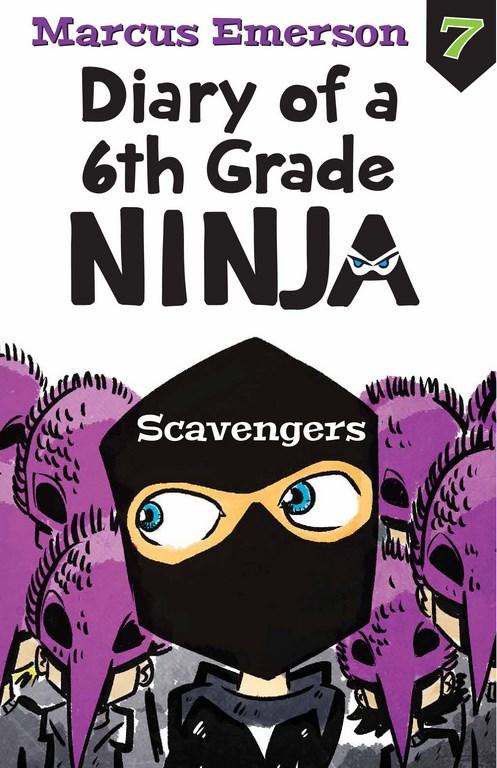
Diary of a 6th Grade Ninja 7: Scavengers

Diary of a 6th Grade Ninja 7: Scavengers by Marcus Emerson (Allen and Unwin)
PB RRP $12.99   ISBN 9781760295615

Reviewed by Daniela Andrews

‘“We will destroy you for rejecting our invitation, but not with bruises or black eyes …”
“It’s your legacy we’re after,” the boy said.’

Chase doesn’t think his enemies can get much worse than pirates, red ninjas and wolf packs. Then he meets a new breed of kids operating behind the scenes at Buchanan School: the ‘Scavengers’.

Sebastian lost his title of President at the end of the sixth book so … guess what? It’s election week! Chase is super proud of his cousin, Zoe, and best friend, Brayden, for running in the campaign. Then he gets ordered by the elusive Scavengers to join their clan as well as run in the election himself. They want to assert their control over the school by ensuring a Scavenger wins the presidency, and they plan to help him win. Chase is annoyed. Who do they think they are? When he angrily tells them he would never run against his cousin, nor join their ‘creepy little gang of rubbish pickers’, they furiously tell him to prepare for ‘a whirlwind of disaster’. And they’re not wrong.

To get revenge, they enter Chase into the presidency campaign themselves. They then create a stealthy, ‘smear’ campaign that first angers Zoe and Brayden, then the whole school. Chase has never felt so hated, but the Scavengers have threatened to turn on his friends if he tells people who is behind the campaign. In true ninja style, there’s no way Chase is going to let them threaten his honour: ‘Things have got better, and I’ve changed. I didn’t want to get lost in the crowd anymore.’

Fans of the series will love this latest installment, which definitely shows some character growth and maturity. The story is action-packed and fast-paced. There are new characters to meet – Naomi, one of Chase’s ninja sidekicks, and Melvin, the school reporter. There are plot twists and betrayals, and there are discoveries … for not only will readers learn who the leader of the Scavengers is, but they’ll also find out who the mysterious white ninja is!


Friday, 5 May 2017

There’s a Tiger in the Garden

There’s a Tiger in the Garden by Lizzy Stewart (Murdoch Books)
PB RRP $14.99  ISBN 9781847808073

Reviewed by Daniela Andrews

There’s nothing to do at Grandma’s house, or so Nora believes. Even her toy giraffe, Jeff, is bored. Then Grandma suggests a play in the garden with the giant dragonflies, hungry plants, grumpy polar bear and … the tiger. ‘I’m too old for silly games!’ Nora tells her, but she heads outside anyway. First, she encounters giant dragonflies … but she remains doubtful about everything else. Next, she’s forced to rescue Jeff from a hungry plant … but no way is she going to find a polar bear or ‘this ridiculous tiger anywhere’. Then the grumpy polar bear does indeed make an appearance … but she’s still 100 per cent certain there is no tiger in the garden. Is there?

This is a lovely picture book about the power of imagination, beautifully illustrated in hues of green that make a humble back yard look like a jungle. Lizzy Stewart uses digital software to overlap the plants and wildlife, giving the pages a vibrant 3D feel. The colours are always textured, creating the effect of a painted picture with overlaid pencil for finer detail.

The friendly tiger definitely reminded me of Judith Kerr’s tiger in The Tiger Who Came to Tea, both in personality and in looks. Unlike Sophie, however, Nora is not so nonchalant about meeting a tiger. The story even takes on an existential feel when both the tiger, and Nora, question whether the other is real and how they can know for sure.

There are a great variety of sentence lengths and font sizes throughout, making the story suitable for 4–6-year-olds. Nora finally lets her imagination take over and the story finishes with a wonderful twist!


Thursday, 4 May 2017

Old Pig

Old Pig written by Margaret Wild and illustrated by Ron Brooks (Allen and Unwin) HB RRP $24.99  ISBN 9781760293895

Reviewed by Daniela Andrews

It’s hard to believe it has been over 20 years since Old Pig, a heartwarming tale about the circle of life, won the CBCA Picture Book of the Year Award (1995). Thereafter, it went on to receive a number of other awards and nominations around the globe!

Granddaughter and Old Pig have lived together for a very long time, sharing everything – including their daily chores. When Old Pig hints that she might not ‘live forever’, Granddaughter feels afraid. Then Old Pig starts to feel tired and, one day, doesn’t even get out of bed. Granddaughter is very worried. When Old Pig forces herself to get out of the house the next day, saying she has lots to do and ‘must be prepared’, Granddaughter knows she must soon say good bye.

Old Pig sets about returning library books, closing accounts and paying bills. Then she comes back for Granddaughter and, together, they take a walk around the town so Old Pig can ‘feast’, but not on food … ‘on the trees, the flowers, the sky – on everything!’ What follows is a beautiful celebration of the senses and of nature. Old Pig teaches Granddaughter to appreciate the colours, smells, sounds and tastes of the world. In the heartwarming end to the story, Granddaughter holds Pig tightly as she sleeps – just like Old Pig used to hold her at night when she was little.

Margaret Wild and Ron Brooks have brought us much joy with their countless contributions to children’s literature. (They are also the award-winning team behind the book Fox, which won the CBCA Picture Book of the Year Award in 2001.)

Ron Brooks’ expressive illustrations are well suited to the thought-provoking text. His gentle line work – subtle forehead creases, downcast eyes or mouths and posture – perfectly evokes the emotions of the pigs. It is wonderful to see this new hardcover release of the book, marking its 20-year anniversary. It will no doubt touch the hearts of a whole new generation of young readers.


Wednesday, 3 May 2017

My Friend Tertius

My Friend Tertius written by Corinne Fenton and illustrated by Owen Swan (Allen and Unwin)  HB RRP $24.99  ISBN 9781760113827

Reviewed by Daniela Andrews

It is Hong Kong, 1941, and Arthur and Tertius are best friends. Arthur spends his days decoding Japanese air force signals for British intelligence. Tertius spends his days springing about the office furniture like the ‘inquisitive trapeze artist’ that he is. Tertius is a gibbon.

When Arthur is ordered to leave Hong Kong, he can’t bear to leave Tertius behind. He sneaks him onto the ship to Singapore, where they ‘live the high life’ … until the Japanese fighter planes arrive. Arthur is ordered to evacuate immediately. He takes Tertius with him, barely making it onto the last ship out. His journey eventually leads him to Australia. He successfully smuggles Tertius into the country, until a police officer discovers him in their Melbourne hotel room. Tertius’ illegal status means his life is in question, but he is sent to the Melbourne Zoo after Arthur begs for an alternative fate. Before long, Arthur is summoned to London. He leaves, heartbroken, but comes back to visit Tertius in 1947 after the war is over. The story ends on a tender note, with Tertius not only remembering Arthur but also wrapping ‘his arms about [him] as if he’d never let go’.

This is a heartwarming, true story, told by award-winning writer, Corinne Fenton, and superbly illustrated by Owen Swan. Though Fenton acknowledges the wartime setting, she states that ‘it’s not a war story’ but ‘a love story between a man and his beloved pet’. The story is told from the first-person perspective of Arthur, and is quite informative. Younger readers might find the war themes quite confronting, with vivid language describing the bombings and their associated terror. (‘There were bombs whistling, exploding, shattering, but worst of all was the screaming. Tertius trembled in my arms.’) The suggested age group for this picture book, therefore, is 5–8 years.

Swan’s pencilled sketches appear in a soft, vintage palette throughout. He varies and limits the colours on each page to great effect, with frightening war scenes often depicted in only two or three tones. The washed-out appearance of the pictures perfectly complements the historical setting.

This talented duo have beautifully told Arthur Cooper’s story of companionship, loyalty, and the importance of holding on to love during times of war.


Tuesday, 2 May 2017

Diary of a 6th Grade Ninja 6: Buchanan Bandits

Diary of a 6th Grade Ninja 6: Buchanan Bandits by Marcus Emerson (Allen and Unwin) PB RRP $12.99  ISBN 9781760295608

Reviewed by Daniela Andrews

Forget the pirate slang from the second book in this series.  Chase Cooper is about to become annoyed with an entirely new sound: chewing. Well, the chewing of gum to be exact. Someone is running around stealing everybody’s chewing gum. It’s all a bit strange to Chase, and, true to style, he’s not particularly sure he cares. Then Wyatt approaches him and suggests they team up to find the mysterious gum-stealing bandit. Wyatt? His enemy?

Zoe once again takes on the voice of reason: ‘“It’s easier to get dragged down by someone than it is to pull them up.”’ Chase is suspicious about Wyatt’s motivations, but his curiosity wins out and he agrees to help. So begins another crazy week at Buchanan School, where Chase has to figure out who the bandit is. Is it Jake, leader of the ‘wolf pack’? Sebastian? The white ninja? Wyatt? Or the so-called ‘scavengers’ his new friend, Naomi, tells him about? Chase is also trying to deal with ‘Career Week’ at school, and an embarrassing mentor. And why on earth is everybody going nuts over the erasers Sebastian has started selling? It’s all a bit much, but Chase manages to put the pieces together in a hilarious dream featuring James Buchanan himself. (Plus a kitten howling at the moon.)

Fans of this series will again appreciate the whimsical characters and storylines, along with social issues concerning this age group (7–12):
‘As a sixth grader, I feel like my entire life is sometimes controlled by what’s cool and what’s not.’
Chase learns a serious lesson about what he thinks is cool, and what is actually cool, from none other than a clown. Themes of bullying are once again addressed in a hilarious scene where Chase learns that clowns can do more than make people laugh – they can also scare your enemies senseless!