Showing posts with label Gecko Press. Show all posts

Friday, 28 October 2022

Wooolf!

Wooolf! by Stephanie Blake (Gecko Press) PB RRP $16.99 ISBN 9781776574834

Reviewed by Nikki M Heath

A reinvention of the classic cautionary tale boy who cried wolf, a little rabbit enjoys tricking his parents with cries of ‘Wolf!’ and using their distraction to do even more naughty things - until the tables are turned.

The cheekiness of this version keeps the reader engaged right to the end - with a final surprise that will make everyone giggle.

Translated from French by Linda Burgess, the text is punchy and doesn’t appear to have lost anything in the way of impact from the original. The illustrations are bold and each page is saturated in deep colour. This feels a bit busy on some pages and dilutes a key moment in the story, despite highlighting the white rabbit characters.

A fun book to share with 2- to 5-year-olds, who will enjoy the naughtiness of this subversive take on a classic.

Saturday, 25 June 2022

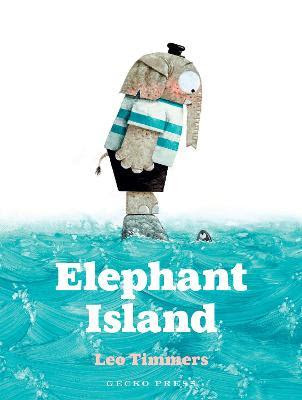
Elephant Island

Elephant Island by Leo Timmers (Gecko Press) HB RRP $27.99 ISBN 9781776574346

Reviewed by Kylie Buckley

Arnold, the seafaring elephant, finds himself shipwrecked and all alone in the middle of the ocean. He swims to find refuge on a tiny rock island, but he is stranded. Eventually, a ‘mouseboat’ approaches and the overzealous elephant accidentally ruins any chance of rescue. Unfazed by adversity, he turns the negative into a positive. With some creative engineering, Arnold builds an extension to the island with the remnants of the mouseboat. Arnold takes more care when the next boat approaches, but the result is the same. Once again, he builds an extension and shares the sanctuary with his fellow shipwrecked friends. After a few unfortunate incidents, Arnold transforms the island into a unique place of entertainment. It attracts a myriad of lovable characters and becomes a hive of fun and frivolity where no one wants to leave.

Elephant Island is a hilarious picture book highly recommended for an audience aged 4 years and older. The detailed illustrations beautifully extend the text and provide a visual delight for young eyes. The book’s themes include positive thinking, problem-solving and friendship.

Leo Timmers is a multi-award-winning Dutch author/illustrator. This book was originally published in the Netherlands with the title Het eiland van Olifant. This English edition has been translated by James Brown.

Tuesday, 10 November 2020

The Inkberg Enigma


The Inkberg Enigma
by Jonathan King (Gecko Press) PB RRP $27.99 ISBN: 9781776572663 

Reviewed by Nikki M Heath

Miro and Zia stumble across something fishy happening in their small fishing town and decide to investigate. They soon discover a cover-up which upends the received narrative of their town’s history, and a network of corruption and blackmail weaving through the fabric of their key institutions. With a camera and an antique ship’s log, they set out to tear it all down.

This is a graphic novel, but it is far from a quick read. The book is a quality production running to 125 pages of detailed dialogue and illustration. It has multiple layers of plot and threads in important details from the earliest panels. The dialogue is natural and supported by expressive illustrations of the characters. The panels transition easily from detailed, tension-building close views to sweeping landscapes and thrilling action scenes. 

The protagonists have a quirky individuality which is immediately appealing. We rapidly discover that Miro, a slightly gawky hat-wearing lover of old books, is not quite the nerd he may appear on face value. Zia has blue hair and a broad rebellious streak but is clearly guided by a strong moral compass. There is admirable diversity represented despite the small remote town setting.

This is an intriguing book for lovers of graphic novels and anyone aged 8 to 12 years who enjoys a page-turning mystery. A particular asset for reluctant readers, especially fans of the big-screen comic-inspired universes.

Monday, 31 July 2017

See you when I see you

See you when I see you by Rose Lagercrantz, Illustrated by Eva Eriksson
(Gecko Press) PB RRP $15.99   ISBN 9781776571307

Reviewed by Dawn Meredith

Rose Lagercrantz is a popular Swedish author of books for children as well as adults. She has received many of the top Swedish literary awards, including the August Prize and the Astrid Lindgren Prize. Eva Eriksson is one of the world’s great illustrators. She has been nominated for the Hans Christian Anderson and other international awards.

See you when I see you is a beautifully illustrated chapter book for children aged 5 to 7.  The quality of the physical book is stunning with a heavy, semi-Matt cover and a good thick presentation which gives this age group the feel of a novella. The large print makes it easy to read and allows for a plethora of illustrations on almost every page. Erickson’s black-and-white sketches are full of emotion, action and character. She brings the characters to life, showing how they relate to each other with eye contact and facial expressions. It is obvious from the affectionate detail of these illustrations that Eriksson was in love with this story. The sheer joy on the faces of children on page 74 – 75 bear testament to this.

Set in Sweden, the story provides a unique snapshot into the life of Swedish children, showing the style of their particular houses and streets as well as indigenous animals such as moose. The names of the children are highly accessible to English-speaking speaking readers – Ella, Dani, Vicki, Mickey but with Swedish place names such as Solna and Skansen adding interest.

The central friendship between Ella and Dani (Daniela) is beautifully told, through the ups and downs, mistakes and misunderstandings and the affection and commitment they have to each other.

The teacher didn’t seem to be angry any more.
“And I thought you were making things up!” was all she said. “There’s still a lot for an old fox to learn.”
“Fox?” Dani looked at her.
“So they say,” answered the teacher.
Dani nodded.
It wasn’t always clear what people meant. But one thing was clear: Ella wasn’t happy. Ella was sad. And Dani was sad too.

Themes of loss and misunderstanding run like a thread through this story, adding a sense of desperation when Ella moves away and Dani’s mother dies. Dani misunderstands her father’s intentions when he falls in love again after losing his wife. Dani’s father misunderstands her friendship with Ella when Dani refuses to have a close relationship with any other children in her class. He doesn’t seem to realise his newfound love is a source of pain for his daughter. Ella’s class teacher misunderstands her need to reconnect with her old friend. Ella herself misunderstands when she realises the treasure the two girls buried is gone not knowing Dani has collected it. She is convinced the friendship is “in jeopardy.”

What is lovely about this story is the natural and very open way it shows conflict in a family in periods of stress. With the death of her mother Dani struggles to cope with the children in her class teasing her and her father’s newfound love. Her friend Ella moving away was the last straw, so finding Ella again on a class trip to the zoo and re-establishing that connection is extremely important to her sense of happiness and well-being. Eventually the adults in her life figure this out too.

Everyone wants a best friend. Everyone has high expectations of that friendship. But sometimes life interferes with what we want and perhaps that is the overall message of this book - when things fall apart there will be someone in your life who understands and is there for you, but you must communicate and trust them with your heart.

The only criticism I have of this book is the complexity of some of the vocabulary used in the text, perhaps due to it being a translation from Swedish. Some of the words are above a seven-year-old’s reading vocabulary, such as knowingly, hurried, meringue, quietened, hesitated. Therefore I would put the independent reading age of this book higher, 8 years+. It would still be a lovely book to read to a young child from age 6 years and up.


Thursday, 8 June 2017

Bruno - Some of the More Interesting Days in My Life So Far

Bruno - Some of the More Interesting Days in My Life So Far by Katarina Valckx, illustrated by Nicolas Hubesch (Gecko Press) PB $19.99 ISBN 9781776571253

Reviewed by Dawn Meredith

The cover of this graphic novel to suit readers aged 5 to 9 years is very appealing with its simple cartoon style architecture and a small black cat, Bruno, as the main character. In some ways the content of this book is rather adult in its sentiment. To me it feels like the sort of story a parent would tell a child at the end of a trying day.

All the characters in this story are animals, with Bruno’s best friend being a horse called Ringo, his other friend Gloria being a shop keeping cow, Georgette the turtledove and his nemesis “the Dreadful Gerard” who is a grey wolf.

Six different days are examined in this book, the first being: A peculiar day, followed by, A rainy day, A day when the power went out, A stupid day (that ends pretty well), A much less interesting day and An almost perfect day.

Bruno is a rather compassionate little fellow who rescues smaller animals from a dire fate such as a tiny fish being forced to drink milk and nearly dying because it’s kept out of water. Bruno defends his little canary friend Tweety from an intimidating crow by letting out his ‘inner lion’ and roaring ferociously.

When Bruno’s friend Gloria calls him over to help her with a tiny problem – a canary flying around inside the shop he assesses the situation immediately:

“At Gloria’s, I saw the canary right away. He was all crestfallen.”

Hilariously, Tweety speaks but mixes up his words. Bruno is the only one who seems to understand him.

 “Caramel for the bridges,” Tweety said.
“You see? He talks nonsense.”
“Would you like to come on a picnic, Tweety?” I asked.
“Motorcoach,” Tweety replied, with a faint smile.

These stories are powerful in their simplicity with themes of friendship, compassion and awareness of differences. It reads more like an allegory or parable rather than a true story. Bruno has a matter-of-fact way of stating reality as he intuitively deals with the elements of his day, such as a car full of wild boars making a nuisance of themselves, or the situation where he had to let out his inner lion. After misunderstanding a situation with a raccoon and a crate of carrots, Bruno realises he can’t save everyone and always do the right thing.

“So much for helping the poor. I didn’t become a hero after all. At least, not that day. But I’d done my best and that’s not bad. (Ringo told me that to cheer me up.) Georgette suggested we go and get ice cream. The last item on my list! It’s not as easy as it seems to have a perfect day, but good ice cream helps a lot. Yum.”

In many ways Bruno represents the best in all of us, the inner coach who spurs us on to be optimistic about life and to do our best despite failures. I think this book is suitable not only for children but perhaps for adults too. There’s a really nice message here – an acceptance of what life throws at you and encouragement to hold onto simple faith in the goodness of things.

“That day, the power went out on my street. At night, so as not to be in the dark, I lit candles. It was very pretty. Since they don’t happen very often, I really like days when the power goes out.”


Wednesday, 7 June 2017

The Lost Kitten

The Lost Kitten by Lee, illustrated by Komako Sakai (Gecko Press) HB RRP $16.99 ISBN 9781877579554

Reviewed by Dawn Meredith

I have to say out of the three books released by Gecko Press this one is my favourite, simply because the illustrations are so stunningly beautiful. Komako Sakai uses a palette knife on board, with layering of simple opaque, pastel colours contrasted with charcoal greys and sparse Matisse-like black outlining, but the most stunning thing of all is the rendering of cats and kittens. This artist has an amazing ability to, with a few strokes, show the angular lines of a cat’s body as well as the softness of fur.

The story follows a little girl named Hina, who finds a skinny, scruffy kitten on the doorstep one day, behind which sits a mother cat and two other kittens. The understanding is that the mother cat is asking them to take care of her baby. At first Hina is unappreciative of the tiny cat saying “if we’re going to have a kitten I’d rather get a cute one from the pet shop.”

Her mother gently shows her how to care for the kitten, cleaning it with a soft wet towel, wiping the goo out from its eyes. Hina softens towards the creature and is drawn into the spell of wonder at its tiny life.
Hina stroked the kitten as gently as if she were touching butterfly wings. The kitten seemed to like it. Hina slipped her hand under its tummy and lifted. It was so soft and light. When she held the kitten, its tummy moved in and out and it purred deep in its throat. “Even though it’s so tiny,” Hina said, “it’s alive.”

As Hina learns to understand the kitten and its instinctive ways such as lapping up milk with its tongue and hiding under cupboards she also learns how to care for it, providing a bed and a collar with a bell and thinking up names for it.

But as her mum leaves the house to go and get food for the kitten Hina realises it has disappeared and she panics. It reminds her of a time when she was lost while shopping with her mother. The fear she felt on that day she now ascribes to how the kitten must feel, for she is sure that it is lost too.  Hina searches for the kitten and promises to be its friend. She persists, realising how much it means to her. As she puts on her coat to go searching outside she finds it at the bottom of the cupboard curled up with a sweater. The cat is thus named Sleepy and so begins the friendship.

The gentleness of the story, translated beautifully from Japanese, is very touching. Somehow the artist manages to convey the harshness of life as a wildcat with the softness of the kitten’s fur and the progressive softening of Hina’s heart. It’s a beautiful book and in hardcover edition is a comforting heirloom. Suitable for ages 2 to 5 years.


Tuesday, 6 June 2017

That’s Not a Hippopotamus

That’s Not a Hippopotamus by Juliet Maclver and illustrated by Sara Davis
(Gecko Press) HB RRP $29.99 ISBN 9781927271964

Reviewed by Dawn Meredith

For ages 3 to 5 years, That’s not a hippopotamus is a brilliantly illustrated and very clever picture book. Davis’ characterisations of the children, and in particular the teacher, are genius.

When a class of very young children go on an excursion to Don’s Safari zoo they are intent on finding a hippopotamus which eludes them for most of the day. Ranger Don leads them on a ridiculously funny adventure as they fly across the pages kicking up dust, laughing, screeching with fear or delight and having a wonderful time in search of the hippo. During their adventure they manage to come across Ibex, giraffe, zebra, elephant, warthog, boa constrictor, a selection of reptiles, a hilarious collection of birds hiding in a forest scene and a walrus until eventually the hippo sneaks up behind and dressed as a tourist.

Davis’ colourful illustrations on white background are perfect and the children’s facial expressions and individual little characters are a delight. The harried spinster-like teacher survives being strangled by a boa constrictor and rubbed up against by a friendly warthog.

Maclver’s rhyme flows beautifully providing just enough hints for Davis to explore a variety of animals. I particularly like the background stories on each page.
“A missing hippopotamus!
Need a hippo–spotter, Miss?
Good thing we’re here, the greatest band
of hippo–hunters in the land.
I see him, Miss! He’s very quick!
I’ll chase him with my pointy stick!”

Maclver and Davis are an exceptional combination. I’m sure this story will be read over and over and delight the reader and listener every time.


Wednesday, 16 November 2016

Gus’s Garage

Gus’s Garage by Leo Timmers, illus. and original text  James Brown (Translation) Gecko Press NZ, 1 Sept 2016, 32pp., $16.99 (pbk),  ISBN 9781776570935

 In the opening of this story, Gus the pig appears to be a bit of a hoarder, with all sorts of bits and bobs stacked beside his garage – old fridge, bathtub, armchair, drums, tyres and the like. But as his animal friends come to his garage for help, it becomes apparent that Gus is an amazing engineer, devising incredible creations from his stash of junk to modify his friend’s vehicles for their comfort.
The illustrations in this book take centre stage. Painted in acrylic, the full page illustrations are rich both in colour and humour. There is so much fun to be had in the visual narrative, from Gus’s amazing creations to many smaller quirky details that will have children poring over each page and guessing what Gus might use next.
This is a beautifully balanced book, with Gus’s garage on the left of every page and his friends driving their vehicles up to, and away from the garage on the right side of alternate pages. Subtle illustrative changes mark the passing of time, like the sky darkening and Gus getting greasier as the day progresses, and the addition of a different bird hiding amongst the junk. At the end, Gus is left with a handful of things –will he be able to help himself after helping everyone else? Children will love the hilarious conclusion.
The text is sparse, allowing the illustrations to shine. Originally published in Belgium, the English language translation by James Brown features simple, short rhyming couplets and a repetitive refrain that perfectly match the humour of the pictures.
A showcase for recycling, inventiveness, engineering and friendship, this book is highly recommended. For ages 3-8 years.


Saturday, 4 January 2014

Dunger

Dunger by Joy Cowley (Gecko Press)
PB RRP $16.99
ISBN 9781877579462
Reviewed by Anastasia Gonis

Themes of generational differences and sibling relationships are covered in this brilliant book by the talented New Zealand author, Joy Cowley. The story has a character driven plot and is told in alternate chapters from the point of view of eleven year old William, and his fourteen year old sister Melissa.

With money as an incentive, the siblings agree to spend their vacation helping their grandparents repair their home. Home is an old wood hut. But this lack of modernity is nothing compared to the strangeness of the two old hippies. Between them they have seeing, hearing and mobility problems. There is no mobile reception, an old wood stove is used for cooking, and the water pipe frequently gets flooded out by rain. What have they gotten themselves into?

Will and Melissa are forced to stay the ten days or forfeit the money. They find that country living can become an adventure as they learn practical and valuable life skills, initiative and resourcefulness. Discovering unknown things about their father’s childhood, both realize the importance of knowing about their family’s past.

This is a fantastic read, realistic and clever. The characters are outstanding and readers will come away satisfied that they have learned a great deal about life from the contents of this excellent novel.

Friday, 8 November 2013

Hannah’s Night


Hannah’s Night by Komako Sakai (Gecko Press)
PB (with flaps) RRP $16.99
ISBN 9781877579554
Reviewed by Anastasia Gonis

This gorgeous book comes to us translated from its original language, Japanese, and from the illustrator of The Bear and the Wildcat. With its thick brush strokes of variegated blues and greens it is a book of the night to be read before bed.

Seeing the world during the day can become common place, and the beauty of the night can go undiscovered because of sleep. But a child discovering the night can be frightening, or it can be an adventure. When Hannah wakes one night while everyone else is sleeping, she embarks on a journey into another world.  There she sees and does all the things that aren’t available to her during the day.

This is a delicate reflection on freedom through a child’s eyes. At times children are fearless, and because of their curiosity, forbidden things like a sister’s doll, her notebook and colouring pencils, and the contents of the refrigerator become mysterious and magical.  So it is for Hannah.

This delightful story is as soft as the night and as gentle as dawn’s first light.

Monday, 23 August 2010

Anton Can Do Magic

Anton Can Do Magic written and illustrated by Ole Konnecke (Gecko Press)
PB RRP $14.99
ISBN 9781877467639
Reviewed by Dawn Meredith

This story is wonderfully humorous, as we follow Anton’s attempts to make various objects and people disappear, as if by his own mysterious powers of magic. There is a sub-story, about a little bird, belonging to Anton’s friend Greta, which has gone missing from its cage. Somehow it winds up being the star of Anton’s magic trick, for which he finally receives the accolades he is wanting!

Konnecke has chosen a powerful, orange-yellow background for the cover, with cartoon figures reminiscent of the comic strip ‘Peanuts’. They do have a certain appeal, and stand out as very different from the typical picture book style of illustrations. It’s a cute story and by giving Anton a turban, Konnecke reminds us of “The Great Sorcar, World’s Greatest Magician”, whose picture appears on the title page as a fuzzy, old fashioned poster.

Dawn Meredith writes from the Blue Mountains. You can follow her exploits here: http://www.dawnmeredithauthor.blogspot.com/