Showing posts with label Fremantle Press. Show all posts

Tuesday, 6 August 2024

Right Way Down

Right Way Down, poems chosen by Rebecca M Newman & Sally Murphy, illustrated by Briony Stewart (Fremantle Press) PB RRP $17.99 ISBN 9781760993429

Here is an anthology of poetry for upper primary school students aged 9 to 12 years by Western Australian poets from a range of diverse backgrounds. Some, such as Sally Morgan, AJ Betts, Meg McKinlay, and Dianne Wolfer, are well-known, but there are many ‘new’ talented poets such as Jake Dennis, Nanci Nott, Julie Watts, and Sian Turner.

The poems are gathered under headings, Come on In! Creative Thinkers, Creature Features, The View from Here, and Coming Home. Overall, it is interesting to note that most of the poems fall under the categories of landscape, weather, and animals, with no poems about family, school, food, or sport, all topics of interest to children. In fact, there are few poems where a child is central to the poem. The exceptions are Xanthe Turner’s ‘Nightmare Nights’, Jen Banyard’s prose poem, ‘You are Here’, Renae Hayward’s ‘Sick’, and Abbey Fields’ ‘She Wanted to Write a Poem.’ Another criticism of this collection is that some of the poems are slight, with fewer than ten lines. There are, as well, only a few lyrical poems. Because the poems were exclusively written by residents of one Australian state (Western Australia), there would obviously be fewer poems from which to choose.

The book is illustrated on most pages with black, white, and grey drawings by award-winning author and illustrator, Briony Stewart. At the back of the book is a surprising inclusion of a glossary of Noongar words. There’s also information about each of the poets, and an acknowledgement to the Department of Local Government, Sport and Cultural Industries which helped with funding of the book. Finally, there is information about the book’s editors Rebecca M Neman whose poetry has been published in Australia and internationally in magazines and anthologies, and Sally Murphy, with over fifty books to her name, and poems in numerous anthologies and journals.


Thursday, 22 September 2022

Noongar Boodja Waangkan: Noongar First Words

Noongar Boodja Waangkan: Noongar First Words by Jayden Boundry, illustrated by Tyrown Waigana (Fremantle Press) HB RRP $24.99 ISBN: 9781760991975

Reviewed by Dannielle Viera

This book is a fabulous introduction to everyday nouns, verbs, and adjectives in the Noongar language of the First Nations peoples who inhabit the south-west of Western Australia. It moves from family members and parts of the body, through plants and animals, and on to time, numbers, colours, and more. At the end, there is an interesting section that covers ‘Noongar things’ such as karli (boomerang), miro (spear thrower), and woonda (shield).

Jayden Boundry is Wadjak Balardong Noongar and Badimaya Yamatji, so he is more than qualified to teach the Noongar language. His choice of words is suitable for both Noongar children keen to connect to their culture, and non-Aboriginal kids who would like to learn about Indigenous vocabulary. Suitable for all ages, the book helpfully includes a QR code that directs readers to a pronunciation guide.

A Wardandi Noongar and Ait Koedhal artist, Tyrown Waigana has created an appealing array of fun and colourful cartoons to accompany the words. While they digest the text, little eyes will also absorb the subtle nod to multiculturalism in the varying skin tones of the people. The animals and birds are particularly adorable and will certainly captivate young readers.

A unique take on the ‘first words’ concept, this book deserves a place on every child’s bookshelf – especially as the United Nations has declared the International Decade of Indigenous Languages, beginning in 2022. By learning the Noongar language, kids of all ethnicities will become more tolerant, compassionate and djoorap (happy).

Monday, 13 June 2022

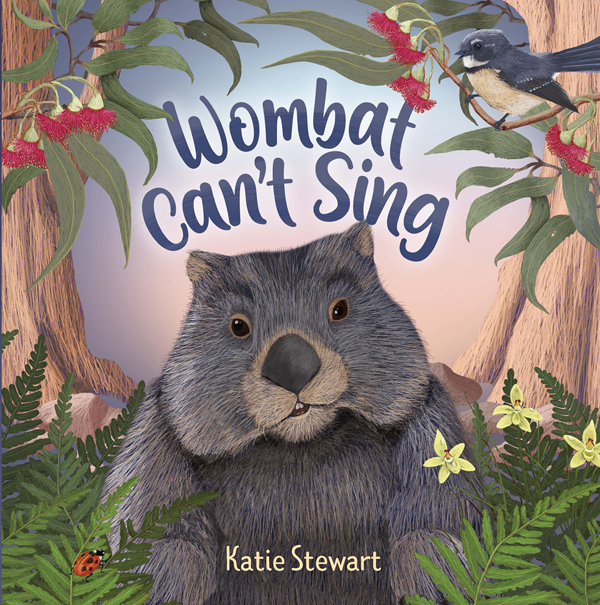
Wombat Can’t Sing

Wombat Can’t Sing by Katie Stewart (Fremantle Press) HB RRP $24.99 ISBN 9781760991456

Reviewed by Nikki M Heath

‘Always be yourself. If you can’t be yourself, be a wombat.’ Lovely advice on the dedication page and a clear indication of the theme of this simple picture book. 

When Fantail invites Wombat to sing with her, Wombat initially brushes her off - after all, wombat’s can’t sing. Or can they? After having second thoughts, Wombat seeks advice from a series of ‘singing’ animals of the bush. But each time, he fails, finally escaping the rain in his burrow. On emerging to find a sopping wet, miserable Fantail, Wombat comes to appreciate what he can do, and stops worrying about what he can’t.

This book has a familiar structure and few surprises, with the wonderfully realistic yet characterful illustrations providing humour and emotional depth. There are also some fun sound effects which will entertain a read-aloud audience.

A gorgeous entry point to a discussion of accepting our strengths and weaknesses for children aged 2 to 5.

Saturday, 28 May 2022

Ninni Yabini

Ninni Yabini by Professor Cheryl Kickett-Tucker, illustrated by Tyrown Waigana (Fremantle Press). HB RRP $24.99 ISBN 9781760991210 Release date 16 August 2022.

Reviewed by Kerry Gittins

This is the tale of a much-loved and adventurous young cygnet who was given the name Ninni Yabini, little star, because she was born on a night when a small star shone brightly in the night sky. Her mother and father, Djidar and Maali, had made a nest of sticks and river grasses for Yabini to keep her safe and warm. They played with her and cuddled her every day. One day, when heavy rain fell, Yabini’s nest was swept away. This made everyone sad, especially Yabini’s mother Djidar, as it was her task to build the nest. But with the help of Yabini’s father Maali, they soon had another, stronger nest built. While Maali and Djidar were putting the finishing touches to the nest, Ninni Yabini saw a willy-wagtail and decided to chase him. She soon became lost and scared, and then night began to fall. That was when Yabini saw a little star shining brightly in the sky and followed it all the way home. Safe and warm in her nest, Yabini feel asleep as her parents sang a lullaby about that same little star. Whenever she was feeling lost and alone, Yabini had her very own star to guide her home.

This dual language picture book for readers aged 2 – 5 years old, is based on a tale from the Wadjuk Noongar people of south-west Western Australia and is told in both Noongar and English. It is set near Derbal Yarrigan, the Noongar name for the Swan River. Author Professor Cheryl Kickett-Tucker is a Wadjuk Noongar traditional owner and was awarded the Member of Order of Australia in 2020 for her significant service to tertiary education, and to the Indigenous community. Professor Kickett-Tucker has brought this traditional story of family, belonging and identity to life with meaningful yet simple text, so that younger readers will be able to read and understand the story in its original Noongar language, as well as its English translation. Tyrown Waigana is a Wardandi Noongar and Saibai Island artist and graphic designer. His illustrations underscore the essence of the story with their vibrant colours and comic-like quality and are a fresh and dynamic complement to the text.

Ninni Yabini is an enchanting new addition to the small, but growing collection of dual language stories that highlight the incredible culture and history of storytelling of our First Nations Peoples.

Supporting teaching themes and ideas could include family, belonging, identity, seasons, indigenous stories and culture, language, indigenous languages, Noongar language, oral storytelling, water birds and black swans.

Teaching notes and activities are available here Ninni Yabini Teacher Notes

Friday, 6 May 2022

Everything You Want to See

Everything You Want to See by Kyle Hughes-Odgers (Fremantle Press) HB RRP $14.99 ISBN: 9781760991371

Reviewed by Dannielle Viera

This board book contains all the things that a child aged up to three years loves to see, from a dog and a horse to a butterfly. It then quietly expands the youngster’s universe to encompass more unusual items – ‘star glow’, ‘a bin that stinks’, ‘a tiger in a car’ – interspersing them with familiar items, such as a rainbow, a bike, and a dinosaur.

Kyle Hughes-Odgers’ text begins simply, with basic nouns. He then increases the difficulty slightly by introducing easy-to-understand verbs and adjectives, as well as a subtle rhyming scheme. This natural progression prepares littlies for the complexity of the English language.

Exploring colour and form in his illustrations, Kyle makes use of warm hues to surprise young eyes, and sudden changes in element size to add interest to the pages. Clever details will delight those who find them: the mouse hiding behind the bin, the basketball in the bike’s basket and the apple perched on the horse’s back.

A perfect size for small hands, Everything You Want to See features arresting images and gentle text. It is sure to become a favourite with babies and toddlers as they begin to explore the world around them.

Wednesday, 20 April 2022

The Vexatious Haunting of Lily Griffin

The Vexatious Haunting of Lily Griffin by Paula Hayes, illustrated by Kay Jiang (Fremantle Press) ISBN 9781760 991753 PB RRP $19.95

Reviewed by Nean McKenzie

Written in first person, this middle-grade novel tells the story of Lilly Griffin, her family, her friends, and a bunch of unspooky ghosts. Set in the fictitious town of Treebark, Western Australia, The Vexatious Haunting of Lily Griffin is three shorter books combined. Each one has a distinct finish before the characters continue to another adventure. The stories cover quite a bit of ground, including the death of a grandma, moving house, the transformation of a brother from a bully into a decent human being, becoming an auntie, the anxieties of making new friends … all while living in the rather magical house of Lilly’s grandfather (GG).

Eleven-year-old Lily’s voice, written in the form of a diary, is distinct right from the start. She loves Harry Potter, is a walking thesaurus and overthinks things just a bit (in a humorous way). She is also able to see ghosts: her great aunt, who she sees trapped in a mirror and a poltergeist called Edgar who is obsessed with cakes. This makes for interesting adventures, which she shares with her new friends Isabella, Cat, and Clive in between games of nettitch and sleepovers.

Amongst the fun and adventures, some more serious topics are touched on. Lily’s nan has dementia and dies. Her mother, who is adopted, searches for her birth parents in Vietnam. There are also dramas between Lily’s father and her older brother Linden, who is having trouble with his marks at school.  While Lily’s journal focuses more on her friends and the ghosts, these things are going on in the background. Over the span of the novel, as she approaches her twelfth birthday, Lily becomes more aware of what is going on around her.

The Vexatious Haunting of Lily Griffin is suitable for 8-12-year-olds. At 440 pages, it is long for middle-grade, but great for those who want to read more about the quirky Lily to have the three books there at once.

Tuesday, 5 April 2022

The Last Light Horse

The Last Light Horse by Dianne Wolfer, illustrated by Brian Simmonds (Fremantle Press) PB ISBN 9781760991302 HB RRP $24.99

Reviewed by Nean McKenzie

The Last Light Horse is the story of the only horse to come home to Australia, out of the 136,000 horses sent to World War 1. His name was Sandy, and he was from Tallangatta in northern Victoria. This book tells of Sandy’s journey from a foal on the Bogong high plains to working as a packhorse in a kiln and when war broke out, to Maribyrnong and on board a ship from Melbourne. From here he travelled to Cairo and was a ‘Waler’ (Australian war horse) in Gallipoli and France. After all this, he was sent to England and then back home, because of the dying wish of an Australian major general.

A lot of research has gone into this true story, as demonstrated by the old photographs and real archival artefacts. These include a Light Horse Manual, a map showing the journey from Alexandria in Egypt to the Somme and newspaper clippings of the declaration of war and reports of battles in Europe. Interspersed with the photographs are charcoal sketches of Sandy on the high plains, the boat and the battlefield. The epilogue of the book shows a photograph of the statue of Sandy which stands on Mount Clarence in Albany, Western Australia (not far from where the author lives).

Sandy was irreparably affected by the war he encountered. He hated being on a boat and was spooked by the battlefield, where horses were ridden and used to pull heavy artillery. When his major general died at Gallipoli, Sandy was transferred to work with a veterinarian in France, to help treat donkeys and horses who were injured by the war. It was here Sandy came across poisoned gas, which partially blinded him. He carried on, regardless of his poor vision, continuing to work until he was eventually transferred home. 

The Last Light Horse is a picture book for older readers. It is the final book in the ‘Light’ series of books by this author and illustrator. These books are set during World War 1 and include Lighthouse Girl and In the Lamplight.

Thursday, 30 December 2021

Backyard Beasties

Backyard Beasties by Helen Milroy (Fremantle Press) HB RRP $19.99 ISBN: 9781760991203

Reviewed by Dannielle Viera

From dawn to dusk and throughout the night, many different beasties appear in suburban backyards. Bats, cats and dogs, as well as more unusual animals – such as bobtail lizards and quendas (a type of bandicoot) ­– all call our gardens home from time to time. And if we look carefully, there are ‘many more still to be found’.

A descendant of the Palyku people of the Pilbara region in Western Australia, Helen Milroy brings a heightened awareness of nature to her stunning book. She captures the sights and sounds of the backyard ­– from clucking chickens to croaking frogs – in simple rhyming text that will appeal to babies and toddlers.

Bold colours and striking Indigenous patterns form the basis of Helen’s eye-catching illustrations. Yellows, oranges and reds reflect the hues of the outback, while deep blues and greens add a refreshing coastal contrast to the book. Small eyes will lap up the detailed dots and lines in the vivid designs.

Printed in a small format that is perfect for little hands, Backyard Beasties will be a much-loved addition to any young child’s library. The brilliant blend of colours, couplets and creatures is sure to intrigue kids again and again.

Thursday, 5 August 2021

Stellarphant

Stellarphant by James Foley (Fremantle Press) PB HB RRP $24.99 ISBN 978 1 760990732

Reviewed by Karen Hendriks

Stella wanted to be an astronaut except there was one huge problem: she was an elephant.


James Foley has created an engaging picture book. Stella is fearless and determined. When she is given reasons as to why she can’t be an astronaut she sets out to find the answers. After all, why should you take no for an answer when you can find a yes?


The opening sentence hooks the reader immediately: One ordinary Monday, at 9am precisely, Stella walked into Space Command. Foley’s dialogue effortlessly moves the story along and gives wonderful insight into Stella. ‘But you have sent some animals to space,’ said Stella. ‘Then why not, an elephant?’


 I love that fact that the elephant in the room is an elephant. This is a funny story that cleverly addresses body type discrimination on a deeper level. Brains and self-belief triumph. I laughed out aloud at the man who kept denying Stella’s application and had to defer to his manager and so on and so on. Until they ran out of managers. Adults reading this story to children will love it as a much as the children. An important message is embedded about not needing approval to do something but following through and doing it yourself. Stellarphant delivers on many levels for a variety of ages. The story builds and builds and Foley leaves the last six double spreads to the illustrations to complete the story, so that it is not crowded with words.


Foley’s cartoon-like illustrations bring multiple layers of meaning and humour to the story. The repeat of blah, blah, blah in the illustrations on two double spreads at a turning point in the story add so much more than any words could. The facial expressions and body language of animals showcase their strength and determination. I love how Foley has allowed for the illustrations to show the countdown to heighten the achievement of space flight. The ending is left open and invites the reader to imagine their own animals flying into space. The endpapers are clever. With the opening one showing both humans and animals together on a hall of fame and the last endpaper being factual and showing a true history of animals in space on a hall of fame. This is a picture book with a true hero – Stella -- that has so much depth and fun.

Saturday, 24 April 2021

Where do the Stars Go?

Where do the Stars Go? by Katie Stewart (Fremantle Press) PB RRP $24.99 ISBN 978 1 760990480                                   

Reviewed by Karen Hendriks

Possum wakes up one morning and wonders where all the stars have gone. He sets off upon a wondrous day of discovery. Each of his friends shares different places where they believe stars are hidden in their environment. But it is not until the end of the day, with a little help from his Mother, that Possum discoveries the true answer.

Katie Stewart is an author/illustrator whose first book What Colour is the Sea? was shortlisted for the Speech Pathology Australia Book of the Year (2020).

In this latest gorgeous and easy to read book, she captures the curiosity and innocence of childhood. Not only does she share the joy of discovery, but she helps a child want to make their own discoveries and seek stars. This book encourages a love and appreciation for nature.

The author expertly uses the structure of question and answer. The repetition of the question ‘Where do stars go in the daytime?’ encourages a young reader to join in with the story and be engaged. The language used has gentle verbs, well placed adjectives, and similes. ‘These stars are like balls of fire,’ he said. Katie shows that each of us see things around us differently, depending on our own experiences. The themes of this book include discovery, imagination, wonder, friendship, nature and the environment.

The illustrations of our Australian flora and fauna are captivating and stunning. This is an Australian picture book that celebrates our unique country. The colour palette has our environment’s rich colours that are so different to other parts of the world. The illustrations slow the reader down and encourage mindfulness, to take in the beauty of each page. This book is filled with double spreads that are mirrors of our vast country. The illustrator pays attention to detail. with each line and brush stroke creating almost three-dimensional images that celebrate our connection to country.

Where do the Stars Go? is a picture book for children aged 2 to 5years. It would make a perfect addition to any home or library shelf. It is also a quintessential gift for a child overseas to help celebrate our Australia. The topics of this book suit the early school curriculum and teachers will find this book a very handy resource. This is a lovely book that celebrates so much about our glorious country and the joy of discovery.

Thursday, 22 April 2021

Mel and Shell

Mel and Shell by Julia Lawrinson (Fremantle Press) PB RRP $16.99 ISBN 9781760990725

Reviewed by Kathleen Grace

It’s 1979. Swedish pop group ABBA rules the airwaves, roller skating is cool, and Mel and Shell are best friends. There is nothing they like more than making up dances to ABBA songs, and there’s nobody they like less than Scary Sharon and Stinky Simon. But things are changing, fast.

The story is told through a series of letters Shell writes to an imaginary pen pal, Mary, from 1892. In her letters she describes things from the present such as record players and television as well as the past (disgusting things such as dunny cans her mother tells her about). By using this style of presentation, dialogue is unfortunately missing from the book and the story which reveals itself through the letters, becomes rather stilted at times. However, Shell learns the importance of loyalty and honesty while showing activities such as BMX riding and roller skating.

This book is ideal for showing children a time when Australian history was told from a single perspective. Lawrinson uses the backdrop of Western Australia’s sesquicentenary celebrations to show how the commemoration of colonisation affects the relationship of the children.

Friday, 22 January 2021

Shine

Shine by Danny Parker, illustrated by Ruth de Vos (Fremantle Press) HB RRP $24.99 ISBN 9781760990213

Reviewed by Dianne Bates

Having six children can’t be easy on Mum or Dad, but this book’s illustrator, who has six children between the ages of 5 and 17, says that through her illustrations she wanted to share the beauty and chaos, the joys and blessings of having multiple children without pretending that it’s easy or smooth sailing. Thus, the double-page fly pages of this picture book show a wide range of chaotic family vignettes from parents playing with their children to children playing among themselves. All look as though they are having fun (and being noisy).

Shine is a love song between a parent and a child, celebrating the beauty and joy of everyday family life, through mess and daily routines. Shine is also a story that seeks to find the beauty in ordinary things- the wonder of a lazy afternoon, the joy of being together. It is an attempt to put words to that spark of connection that we have with each other.

In rhyming couplets such as the introductory, ‘In my lightning, you’re the light. /In my brightly, you’re the bright’, the reader gets an understanding of how family members (just like the reader’s own) interact with one another. In the first double page spread, typically Mum and Dad are asleep in bed, with two children and a baby crawling (and jumping) on the bed. There’s no rest for parents when kids are around!

In other illustrations there is lots of mess, some of which (upturned chairs, sheets) make good hiding spots. Mum gets to sit down for a moment with lots of clutter around her, to have a cup of tea. One page shows Dad and five children – it’s the first time all of them are together. Dad is trying to enjoy a glass of water but baby is crawling over him.

The illustrations really make this book. The children all look joyous no matter what they are doing, from bathing together to raiding the fridge at night. Ruth de Vos’ work as an internationally recognised textile artist, is demonstrated on some of the pages which have woven fabric in the background.

Recommended for readers 5+ years. 

Thursday, 21 January 2021

Backyard Bugs


Backyard Bugs by Helen Milroy (Fremantle Press) HB RRP $14.95 ISBN 9781760990282

Reviewed by Dianne Bates

From the author of Backyard Birds, shortlisted for the Speech Pathology Australia Book of the Year, the latest picture book by Aboriginal Helen Milroy takes the reader into the garden to share her collection of creepy critters. Written in rhyming couplets, this picture book will doubtless teach kids about the scurrying, scuttling, scooting, buzzing, zooming splendour of insects such as ants, dragonflies, beetles and more.

It is a simple book, just the right size for small hands, with beautiful, bold patterned illustrations which showcase Aboriginal art with its use of dots, swirls, and other decorations. The reader will discover that a spider has eight legs, that a caterpillar turns into a butterfly and that ‘snail and slug slip slide on leaves.’ The colours are vibrant, with each left-hand side page displaying the text on full-colour pages, with the insect represented on the right-hand side. The detailed end papers in green and brown show all the insects in the book against whirling patterns.

Thursday, 24 December 2020

Beneath the Trees

Beneath the Trees by Christy Burne (Freemantle Press) ISBN 9781760990411 RRP $14.99 PB 

Reviewed by Claire Stuckey

After travelling across Australia to visit family living in a subtropical rainforest, the first thing Cam and Sophie want to do is see a platypus. Although it is pouring with rain, cousins Liv and Jack walk them to the bridge where they do see a platypus, but it has a rubber ring caught on its neck. Jack decides to help but he slips into the raging torrent. Sophie also slips and Cam dives in to help but the three children are tossed around, eventually escaping wet and cold downstream. Lost, wet, and cold, Cam works hard to return them to safety, but the difficult terrain and Jack’s actions impede their progress. They return after their rescue with a ranger to assist the platypus as the flooding subsides.

Full page black and white illustrations break the text for readers, also providing emphasis to their plight. This is a great action adventure book with interesting factual references including how leeches survive!

Adding to Cristy’s other Australian adventure stories, this title is highly recommended for those children who have moved past simple chapter books.

Sunday, 5 July 2020

My Place by Sally Morgan


My Place by Sally Morgan (Fremantle Press) PB RRP $23:00 ISBN: 9781925816761

Reviewed by Jeffery E Doherty

My Place is a great Australian classic, one of the best loved biographies of Aboriginal Australia ever written. It has now been adapted for younger readers. From the blurb: ‘Sally Morgan always wondered about her family: who they were; where they came from; what they were hiding. She asked questions but received few answers. So, Sally travelled to her grandmother’s birthplace. What started as a tentative search for information, became an extraordinary pilgrimage that would change their lives forever.’

My Place is a search by the author for identity and belonging. The dedication to her family sums up the essence of the book. “How deprived we would have been if we had been willing to let things stay as they were. We would have survived, but not as a whole people. We would have never known our place.”

Sally’s story begins in the mid 1950’s in Perth, Western Australia, as a five-year-old, visiting her father in hospital. All through her childhood, she had questions for her mother and grandmother about their family. Questions like, why did Nan hide whenever she bought friends home after school. Over the years she received lots of evasion and very few answers. This emotive, often heart-wrenching and beautifully written book explores Sally’s search for answers about her heritage. It took her entire childhood, through her university years and into adulthood before she found the answers to her identity. My Place not only tells her own story, but explores the story of her great uncle, her mother and grandmother, giving the reader a glimpse of the inequality and hardships faced by the aboriginal people. What she finally discovered was a rich heritage and the sense of belonging she had been searching for her entire life. She found her place.

I usually read books as an escape from the real world, and it is rare that I read non-fiction or biographies for pleasure. This is not a book I would have chosen to read. I am so glad that Claire from Fremantle Press sent this book to me for review. Not only is it, the sharing of a touching and emotional journey of discovery, it resonates with me on a personal level. I was in my late twenties when I discovered my own aboriginal heritage. Reading My Place has made me even more determined to delve deeper into the rich culture I missed out on as a child. My Place was originally published as three separate books in 1987. It remains highly relevant today. 

This adapted version combines the three books into one volume. I highly recommend this wonderful biography for both adults and younger readers.


Tuesday, 28 April 2020

My Superhero


My Superhero by Chris Owen, illustrated by Moira Court (Fremantle Press) HB RRP $14.99 ISBN: 9781925816464

Reviewed by Dannielle Viera

Superheroes may be ‘tall and very muscly’, with the ability to ‘see through solid walls quite easily’ and ‘dive deeper than a submarine’, but the young narrator’s superhero – their dad – is not like that at all. He climbs trees to rescue them ‘with perfect ease’, he gives hugs that make them feel like they are ‘protected by a coat of steel’ and, best of all according to the narrator, ‘he reads me books!’

Chris Owen’s rhyming couplets dance off the tongue when read aloud, keeping the child listener entranced with every syllable. Although there are two spreads about superheroes for every one spread describing the father, it is clear to the audience that the narrator places their dad above all others – phrases such as ‘my favourite’ and ‘I love it when …’ highlight the importance of the personal connection between father and child.

Turning the idea of a human superhero on its head, Moira Court’s masked characters are all taken from the animal world. Her choice to reserve warm oranges and browns for the spreads devoted to the father’s special skills is a clever one, as it immediately infuses these pages with a unique tenderness.

Chris Owen and Moira Court’s charming ode to the power of dads is being released in board-book form just in time for Father’s Day. My Superhero is perfect for quiet moments at home, when Dad ‘is close at hand to comfort me’.

Wednesday, 22 April 2020

Goldfields Girl


Goldfields Girl by Elaine Forrestal (Fremantle Press) RRP PB $16.99
ISBN 9781925816495

Reviewed by Kylie Buckley

Goldfields Girl is a middle grade historical fiction novel set in the early 1890s,  based on the true story of Clara Saunders.

Clara grew up in a large family who moved all over Australia, chasing the dream of finding their fortune in gold. From a young age she was taught to be reliable, hard-working and independent. This type of childhood gave Clara the confidence to move away from her family at age fourteen, to make her own way in the world. The story follows Clara’s move to Coolgardie, a new remote gold mining town in Western Australia, where she is one of only two females. We soon discover that Clara will experience a range of adventures, triumphs and tragedy in the isolated town.

Goldfields Girl is an engaging novel written in the first person by the strong female protagonist, Clara. It is divided into short chapters, each titled with the month and year. It is recommended for children aged 12+ years, especially those who enjoy learning about Australian history.

Wednesday, 23 October 2019

Antarctica


Antarctica by Moira Court (Fremantle Press) HB RRP $24.99 ISBN 9781925815757

Reviewed by Nikki M Heath

Antarctica is a mysterious place with a wealth of unusual animals, and Moira Court brings ten of them to the page in this striking book. From orcas and two different types of seal, to blackfin icefish and ‘shrimpish, pinkish’ krill, this nature information book offers a few surprises.

Each spread incorporates counting, colours and descriptions of the creatures and their behaviours, making for a multi-dimensional experience with much to explore. The language is vibrant and incorporates sophisticated vocabulary which will be a stretch for younger readers (and even some older ones). The main spreads are followed by four pages of quirky facts about Antarctica and the featured animals.

Court’s hand-made, layered illustrations are striking, using bold yet natural colours and geometric shapes. The creatures are rendered with surprising depth of character, joyous breaching whales contrasting with trudging penguins and beady-eyed squid.

With so much going on, this book will keep readers coming back repeatedly. While the publisher nominates an age range of 3 to 5 years, the book would also be a valuable classroom resource for junior primary students.

Wednesday, 22 May 2019

The Wrecker's Revenge


The Wrecker's Revenge by Norman Jorgensen (Fremantle Press) PB RRP $16.99 ISBN 9781925815450

Review by Wendy Haynes

The Wreckers’ Revenge is a sequel to The Smuggler’s Curse and is suitable for 9-14-year-old readers. It is typically a book for boys having a male-dominated cast of characters, but those who like adventure, action, history, and tales of the high seas will also enjoy the story.


The main character Red Read finds himself in a whole lot of trouble and is expelled from a boarding school after sticking up for a fellow student: he hates bullies. Being told in first person lends to the nature of this action
packed story. 

While imprisoned, he discovers what seems like a treasure map on the wall. Soon though, he is whisked away by Captain Black Bowen his guardian, boards the Black Dragon and sets sail for another adventure, in search of treasure. They soon come to realise that their quest may lead them to discover the lost treasure of William Dampier.

The crew finds they are under attack from the Wreckers’ Pearl Divers seeking revenge from their previous clash. Their ship sinks and they are stranded on an island. But the Captain has a plan to help them off the island and teacher the Pearlers a lesson. From there they continue their journey always with the treasure in mind.

Norman Jorgensen has masterfully woven an abundance of surprises along the way adding the them of growing relationships and a captain who loves quoting Shakespeare into the mix making this fast-paced story a must read.


Sunday, 17 March 2019

Violet and Nothing


Violet and Nothing written & illustrated by Fiona Burrows (Fremantle Press) HB RRP $24.99 ISBN9781925591552

Reviewed by Dianne Bates

Violet is always thinking when she’s eating, playing, feeding her cat, cooking, just living. One day she thinks about ‘nothing,’ but the concept eludes her. What is nothing? Where is it? If nothing is real, is anything real? These are deep philosophical questions for a small girl to ponder. She asks people in her life such as her sister and mother. They come up with ‘answers’ such as nothing is empty space, or blankness.

But when Violet looks at blankness, such as a white page, she can nevertheless see ideas on it in imaginary traces. Inside her mind when it is ‘empty’, she nevertheless has ideas galore. Even in the garden where there’s ‘nothing’ in the air, she can smell and hear. Finally, in her closed hand, she finds ‘nothing’ but that leads to the idea that if nothing is real, how do you know if anything is real?

This book is likely to amuse and puzzle a reader aged 4+ years. Every page shows Violet and the ‘nothing’ she finds – such as the richly colourful ‘nothing’ that occupies her mind. The illustrations of ‘nothing’ are abstract and filled with interesting trivia while the illustrations of Violet and the people in her life are eye-grabbing. This is a picture book about the big questions that children have and that adults often can’t answer.